

Syria’s private sector has long existed in a state of uneasy accommodation with the government. Large family-run conglomerates flourished in manufacturing and agriculture during moments of economic opening, only to be constrained again by state intervention, regional shocks, or war. Over the past fifteen years, that balancing act has become more extreme. Conflict, sanctions, currency collapse, and infrastructure destruction hollowed out much of Syria’s economy, leaving behind a patchwork of surviving firms.
Iyad Betinjaneh belongs to this small, influential category. He is part of a generation of Syrian businessmen whose careers stretch across radically different economic systems: late-Ba’athist state capitalism, partial liberalization in the 2000s, wartime fragmentation, and today’s uncertain reconstruction phase. Analysts of Syria’s economy often describe recovery as a story dominated by state agencies, politically connected elites, or foreign capital from the Gulf and beyond. Yet much of what still functions on the ground—food processing, agricultural supply chains, domestic distribution, and basic financial services—depends on firms like Betinjaneh’s, which combine local knowledge with the ability to operate across multiple regulatory and political environments.
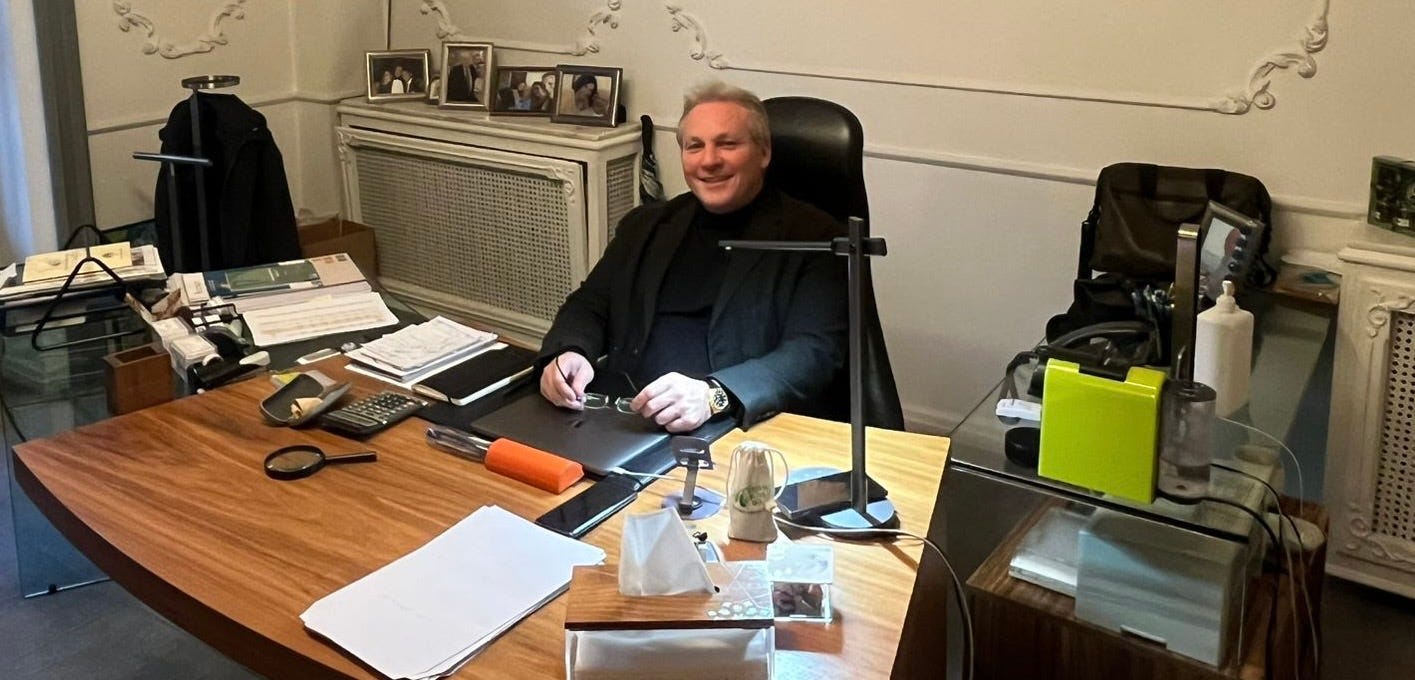
Today, Betinjaneh occupies a set of positions that place him at the center of debates over reconstruction, foreign investment, and the limits of Syria’s economic reintegration. He is chairman of the Bank of Syria and Overseas, one of the country’s private banks established during the financial liberalization of the 2000s; a board member of the U.S.–Syrian Business Council, which has worked to reopen commercial channels between Syrian firms and American companies after years of isolation; and managing director of the Betinjaneh Group, a family-run conglomerate active in agribusiness, food processing, and consumer goods manufacturing. He also sits on the Damascus Chamber of Industry and the Federation of Syrian Chambers of Industry, and chairs companies dedicated to olive oil and edible-oil refining, a sector which remains one of Syria’s few viable export anchors and comprises more than 3% of national GDP.
We spoke with Betinjaneh in Damascus about what it means to operate across these overlapping sectors and why he believes Syria’s private sector, as battered as it may be, remains essential to any credible economic recovery.
You began your working life well before the war and have worked across agribusiness, manufacturing, and banking. How has your exposure evolved over that period?
I started working in the family business in the early 1990s—actually in 1990—while I was still in high school and university, studying economics. I began in manufacturing. One of our earliest factories produced detergents and plastic products, including shoe polish and floor polish, under license from a German company, producing the BUFALO brand. That’s how my career started.
My father spent much of his life traveling across the Middle East, representing French companies from Iraq to Yemen to Egypt. Through his efforts, these brands became well established in the region. In the 1990s, he focused on the Syrian market and started to rebuild, at a moment when the country was cautiously reopening after a long period of economic closure.
As markets began to open, we restarted operations. We moved into distribution, brought in international brands, and expanded manufacturing in consumer goods—mainly fast-moving consumer goods (FMCG). That became the core of our family business. By the late 1990s and early 2000s, imports resumed in earnest, and in 2004, with further opening, we expanded again.
Around that time, we invested heavily in food commodities and agribusiness, especially edible oils. I specialize in olive oil—I love the product and I’m passionate about it. We built oil refineries producing olive, sunflower, and palm oil, and later expanded into canned foods factories: table olives, grape leaves, pomegranate molasses, artichokes. Olive processing, in particular, became central to what we do.
We’re vertically integrated. We produce everything from packaging to the final product—tins, PET bottles, printing, filling, refining—all locally, in-house. We also remained active in detergents and plastics. And our history includes dairy: my father represented major French dairy brands in the Middle East for decades, and today we produce our own line—milk powder, cheese, and other dairy products—under the Halibuna brand. We’re also in pulses: lentils, beans, rice, with a lentil factory in Aleppo that we built recently.
In parallel, we entered services. When private banking began in Syria in 2004, we were among the founding families of the Bank of Syria and Overseas, alongside partners originally from Syria but based in Lebanon. We also helped found Arope Insurance Company around the same period. By 2010, we were distributing close to three hundred brands alongside our own manufacturing operations.
How did that change with the onset of the war?
In 2012 and 2013, we lost seven factories. Warehouses were destroyed, distribution trucks were stolen, and twenty years of work disappeared. It was a massive loss. We had no choice but to leave, and we moved to Paris and then to Lebanon.
Starting over was difficult. I decided to go back to school and completed an executive MBA, partly to stay active and partly to think more strategically. Between the end of 2014 and the beginning of 2015, as conditions in Syria became somewhat calmer, we began looking back.
Still, at the end of 2023, I had no visibility at all. I thought we might close everything. Costs were unbearable, imports blocked, and palm oil was restricted. Operating felt almost impossible. Then, unexpectedly, conditions shifted again in late 2024 and 2025.
How did those changes affect you?
What we encountered after Assad’s fall was a completely different market. There was a sudden, chaotic opening—a tsunami of goods coming from everywhere, with no standards, no quality control, no customs duties. Syrian consumers were curious about the open market and wanted to try new products. At the same time, raw materials were extremely expensive, driven up by 2024-era exchange-rate volatility and a fragmented financial and payments system that trapped capital in Syrian pounds. I often describe it as opening a bottle of champagne: everything fizzes out at once, and then the problems appear.
We knew it would be brutal, so we applied a survival strategy. Strengthen the pillars—keep factories running, absorb losses, protect what remained. I expected the entire year to be a loss, and it was, especially during Q1 and Q2 of 2025. But then we saw another side: millions of new consumers in areas that had previously been outside the market—northern Aleppo, the Jazira. We moved quickly, expanded distribution, adapted products, and tried to capture that opportunity.
At the same time, foreign actors began showing curiosity about Syria. I told my brother: if there’s wind, open the sail. We’ve reinvested carefully.
You now operate at the intersection of agriculture and industry. What do you think are the biggest constraints facing Syrian manufacturers and farmers today?
Historically, Syria is an agricultural country. Until the 1950s, agriculture represented perhaps seventy-five percent of national income. Key industries—sugar, cotton, textiles—were built on agriculture. Even today, agriculture represents around twenty to twenty-five percent of GDP, but it remains the country’s largest employer.
After the war, the challenges were severe. Land was destroyed or burned. People left their lands; many farmers went to Europe. We lost a great deal.
What’s the biggest constraint? First, water. Second, seeds and inputs – good quality seeds, fertilizers, all are expensive or not available due to sanctions. Third, energy – fuel and electricity to run pumps, machines – it’s very scarce and costly. And financing, of course – there’s no financing for farmers or manufacturers, no credit available to them. We’ve also lost easy access to export markets with the sanctions. All these are constraints.
With better technology, higher yields, and partnerships with foreign companies when conditions allow, agriculture and agro-industry can grow again.
But we have opportunities. Syria is historically one of the top olive oil producers. We still have 82 million olive trees. Syria was the number one exporter of apricots, pistachios, and many other fruits and vegetables. Opportunities remain in improving yields through better technology, partnering with foreign firms when conditions permit, and concentrating on high-value crops where Syria retains a clear advantage.
You also sit on the board of the Bank of Syria and Overseas. How is Syria’s financial sector adapting, and what would you say to foreign investors worried about moving capital in and out of the country?
For the past fifteen years, Syria was cut off from the world. Sanctions forced banks to operate in near isolation. We had to be creative, using alternative routes and the few correspondent banks in friendly countries who continued working with Syrian banks, but it was extremely difficult. There were no direct channels. Everything became cash or informal, which raised both cost and risk.
Our bank had to work in a very cautious, survival-mode approach. Banking activity became extremely conservative and limited largely to NGOs, international organizations, and humanitarian transactions for foreign currency transfers. We were very careful to comply with sanctions and economic measures, which meant shrinking our business significantly. At the same time, the local economy shifted away from formal banking toward forwarders, exchange dealers, and third-party intermediaries in order to cope with sanctions. This led to a major contraction of the official banking sector.
Still, the sector survived. The central bank took measures to maintain stability. Financial ratios weren’t ideal, but private banks—especially the conservative ones—held on. The sector did not collapse, which is crucial for any recovery.
For foreign investors, it remains challenging. If you invest now, your capital may be stuck in Syrian pounds; you can’t easily repatriate profits. That was the situation. But given the rapid pace of political change and the introduction of new investment and tax laws, I expect a gradual reconnection with the global banking system. We already see signals – maybe regional banks coming, the potential easing of restrictions, and foreign investors expressing interest in mega-projects. For now, though, foreign investors are starting to look carefully into the local market and for possible local partnerships.
As a board member of the U.S.–Syrian Business Council (USSYBC), what do international partners tell you about Syria’s investment appeal?
Syria has been on the news for fifteen years. Whether good or bad, everyone knows it. Every company knows Syria. That visibility creates curiosity.
Our role at the USSYBC is to turn that curiosity into something positive. Syria today presents enormous reconstruction needs—hundreds of billions of dollars worth. You won’t find that scale everywhere. Still, Syria remains a land of opportunity.
At the Business Council, we worked with many American companies, even during the war. Through the council, we encourage American and other international companies to come, to visit, to see the country directly. At Betinjaneh Group as well, we deal with many American companies and invite representatives to the country. Last month, security and travel restrictions made that impossible for most firms. Now we’re starting to see more positive feedback.
We’re planning symposiums and visits, connecting companies with the right local partners. We’ve also had discussions with major American banks operating outside the U.S., and things are developing in the right direction.
Reconstruction is often portrayed as a government-led effort. What role do private companies play?
There’s a saying: Ahl al-Makkah adra bi-shiʿabiha—the people of Mecca know their streets best. Syrians are on the ground. We understand the country, the history, where investment makes sense.
Our group operates across agriculture, agribusiness, production, hospitality, banking, insurance, and services. We understand the environment. Any foreign company coming to Syria will need local partners.
I often describe Syria as a beautiful jewel covered in dust. Whoever polishes it will benefit. The challenge is scale. Even the largest Syrian companies are limited compared to the size of today’s projects, which require billions. That’s why many major projects are led by Emirati, Saudi, or Qatari firms—and that’s normal and makes sense. But there is a significant portion that Syrians can handle. The know-how is here.
What conditions are most needed for investors to come with confidence?
First, stability—political stability. And frankly, conditions in 2025 have been better than expected. The government is working hard. I see young people working around the clock. The political vision is positive. There’s a sense of safety on the ground here.
Second, opportunity. Syria’s geographic position is extraordinary. It sits at the center of regional trade routes. On the Belt and Road, Syria could be the cherry on top of the cake. Tartous and Latakia ports are real treasures. Syria can be a logistics hub for both China’s Belt and Road Initiative and Western-led logistics projects linking India, East Asia, and Oceania to the West.
I studied this years ago—railways, ports, trade corridors. For a long time, under Assad, it was only theory. Now I see Syria beginning to emerge as a hub for trade, benefiting from its strategic location linking East with West and north with South.
Looking five or ten years ahead, what is your vision—for Syria and for the Betinjaneh Group?
If stability continues, improvement is inevitable. We see positive signals: a very hard-working young government, regional support, a vision of peace. Syria is returning to its place. It is only a matter of time.
Syria also has friends in the region. Prince Mohammed bin Salman uses an image I like: if you have a train moving forward, you add Syria as one of the wagons and take it with you. That’s how I see it. Syria is returning, gradually, to its place.
For Betinjaneh group, we are here. We stayed. Insh’allah, we will continue. Our core remains in fast-moving consumer goods, while we carefully explore new investment opportunities.
The next fifty years will be better than the last fifty. Hopefully, not just for us, but for Syria as a whole. Syria will rise again.