

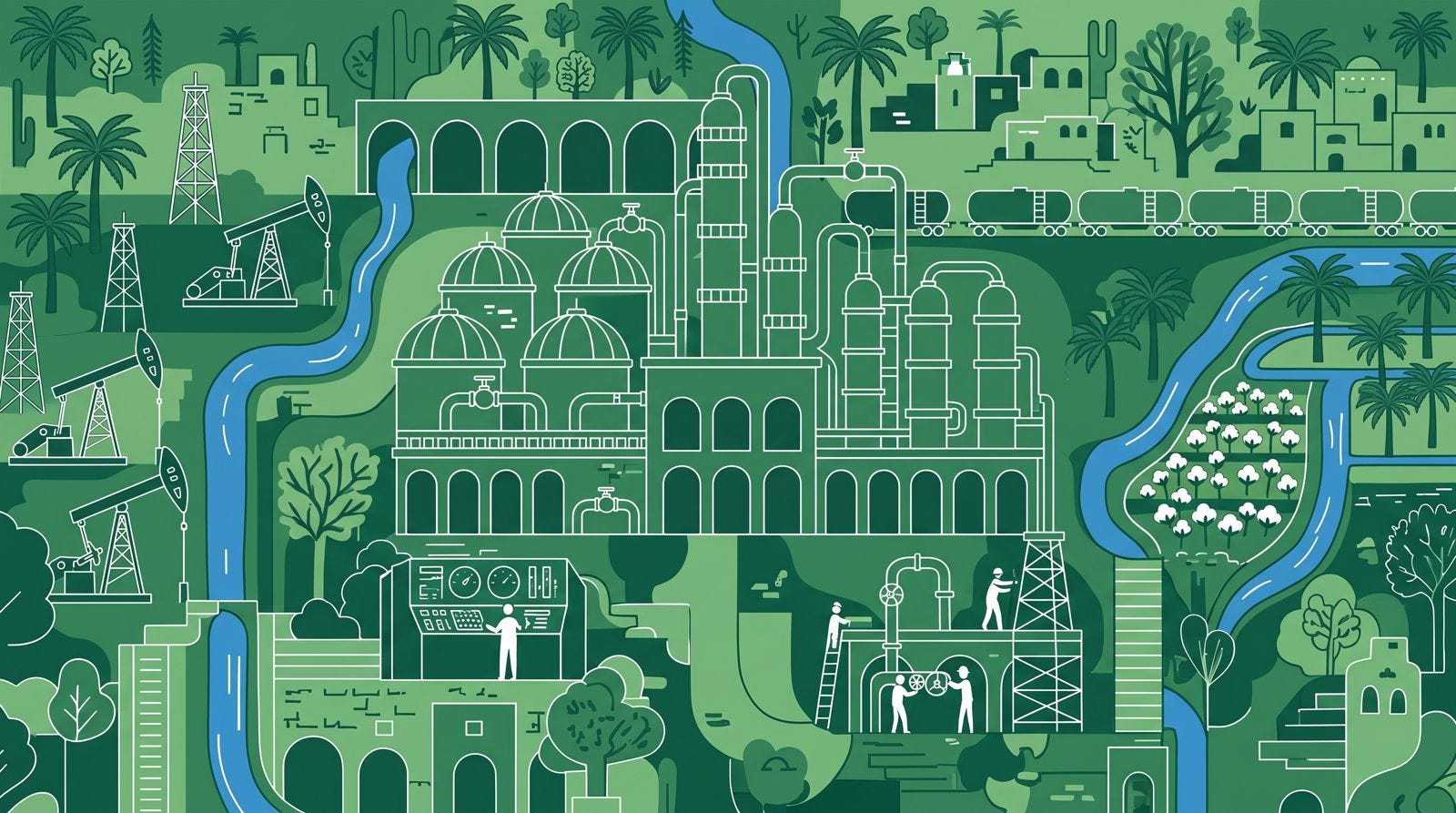
The first six built a single premise, that reconstruction value accrues to whoever controls the point where it is created, whether that point is an industrial base, a set of rules, a corridor, or a port. Deir ez-Zor closes the series by inverting the premise. It is the one place in Syria where the wealth was never in doubt and the question is not how to create it, but why a region that has produced the nation’s wealth for forty years has remained among its poorest. This analysis is written from Damascus, where SIMA Partners has been based since mid-2025, for investors, economic researchers, and policy professionals weighing entry into the eastern hydrocarbon economy. It follows the series framework: what the city was, what was lost, what has changed, the arithmetic, where capital goes, what can go wrong, the parallel, and the thesis.
What Deir ez-Zor Was
At night, from the villages on the eastern bank of the Euphrates, you can see the gas burning. The flares stand over the Conoco and Omar fields, columns of flame that have marked the horizon for years, and beneath them sit settlements that have rarely had reliable electricity. This is the oldest fact about Deir ez-Zor, older than the oil itself. The wealth is visible, and it belongs to someone else.
The people who live under those flares are the human lens of this issue. They are, for the most part, of the Uqaydat, the confederation that dominates the governorate’s countryside, and of its sub-tribes, the al-Shaitat in the eastern reaches and the Bakir. The Baggara, a separate confederation, hold the land further west. Their land holds Syria’s largest oil field. Their villages, until very recently, drew power from private diesel generators and their water from a river whose level is set by dams hundreds of kilometres upstream in Turkey. To understand Deir ez-Zor as an investment proposition, you have to begin with this gap between what the ground produces and what the people on it receive, because closing that gap is the entire thesis.
The modern city is a frontier creation, the Ottomans built it as the capital of a new administrative district, the Sanjak of Zor, carved out in the 1860s and 1870s from territory that had belonged to Baghdad and Aleppo. The purpose was control, the Euphrates desert was the empire’s open flank, the route between Aleppo and Baghdad, and its inhabitants were the pastoral tribes the central state could neither tax nor trust. Istanbul’s answer was to plant a town with a governor reporting directly to the capital, to settle nomads and refugees around it, and to use Deir ez-Zor as the instrument through which the centre managed a periphery it valued mainly for what passed through it. The economy that grew up was real but thin: wheat and cotton on the irrigated banks, fruit, and the Awassi sheep whose meat and milk were known to traders in Baghdad and the Gulf. A Deir ez-Zor historian, Abdul Qadir Ayash, wrote that the region’s oil was a thing one did not speak of, a secret. The frontier produced for others and was administered from elsewhere. That was its founding logic.
The French inherited that logic and industrialised it. When Deir ez-Zor passed under the French Mandate in 1921, the eastern desert acquired a new function in a larger system. The oil of northern Iraq had to reach the Mediterranean, and the shortest route ran across French-controlled Syria. The Iraq Petroleum Company, a consortium of British, French, Dutch, and American interests, built its Mediterranean pipeline between 1932 and 1934, splitting the line near Haditha so that a northern branch crossed Syria to Tripoli. A second, larger line followed in 1952, the Kirkuk to Banias pipeline, eight hundred kilometres of thirty-inch pipe carrying up to three hundred thousand barrels a day to the Syrian coast. To protect this infrastructure, the mandatory powers governed the desert and its tribes as a security problem, a programme one scholar has called the architecture of desert control. For half a century, the eastern Syrian desert was a place crude was pumped through on its way to Europe. Value crossed it. Value did not stay.
Syria’s own oil came late, and it came to Deir ez-Zor. The state began admitting foreign explorers in 1975, and in 1984 a group led by Pecten, a Shell affiliate, working with Deminex and the Syrian Petroleum Company, made the first commercial discovery in the Euphrates Graben at Thayyem, fifteen kilometres south of the city: light, low-sulphur crude. The Al Furat Petroleum Company was formed in 1985 to develop it, with Shell as operator. The Omar field, the country’s largest, was discovered in 1986 with some 760 million barrels in place and reached a peak of roughly 80,000 barrels a day. By the late 1990s a backwater had become, in the phrase of one industry chronicle, a booming city. Oil accounted for around a fifth of national output before the war. And here the founding logic held once more. The revenue was nationalised and flowed to Damascus, and the benefit, by the Assad government’s own administrative classification, did not reach the producing region. Deir ez-Zor remained a developing province sitting on the country’s richest asset. The crude moved west to the refineries at Homs and Banias and out through Tartous; the poverty stayed east.
What Was Lost
When the state fractured, the east fractured first, and the oil became the prize that everyone fought over. By mid-2014 the Islamic State held most of the governorate and besieged the government enclave inside Deir ez-Zor city, a siege that would last three years and two months (Al Jazeera, 2017). Inside the perimeter, the Republican Guard’s 104th Airborne Brigade under General Issam Zahreddine held a shrinking pocket while the population starved. Around 200,000 people were trapped in early 2016; the World Food Programme resorted to high-altitude airdrops, more than 170 of them, to keep the enclave alive; by early 2017, when an Islamic State offensive cut the air bridge, between 110,000 and 120,000 civilians remained (United Nations records; Al Jazeera). The siege was broken in September 2017. Zahreddine was killed a month later by a mine on Saqr Island.
The countryside paid a different and heavier price. In the summer of 2014, the al-Shaitat, a farming sub-tribe of the Uqaydat numbering in the tens of thousands across the eastern reach of the governorate, refused the Islamic State’s authority over their towns and their wells. The retaliation was a massacre: roughly 700 al-Shaitat men were executed over a matter of weeks, documented afterward through survivor testimony and mass graves (Syrian Observatory for Human Rights). The same group that ran the oil as a war economy, trucking crude to makeshift refineries and selling it across the front lines, killed the people who lived on top of it for declining to submit. The city’s physical fabric went too. The old suspension bridge over the Euphrates, built around 1930, was destroyed in 2013. The Armenian Genocide Memorial Church, which marked Deir ez-Zor’s place as the terminus of the 1915 death marches and the destination to which an earlier empire had sent a people to die in this same desert, was demolished by the Islamic State in 2014. A city whose identity was built on being the place the centre used was, once more, the place where the worst arrived.
The economic loss is measured most plainly in the oil itself. A province that had produced around 130,000 barrels a day before the war, roughly a third of national output, was reduced under successive war economies to a fraction of that. National production fell from about 380,000 barrels a day in 2010 to an estimated 40,000 by 2015 and to between 15,000 and 30,000 by 2019 (S&P Global Commodity Insights). The Omar field, which was still producing around 50,000 barrels a day on the eve of the war in 2011, fell to a few thousand, and the decline was not only a matter of who held it: years without investment, without spare parts, without pressure maintenance, hollowed out the reservoirs themselves. This is the loss that outlasts the war. A front line can move in an afternoon. A damaged field recovers over years.
What Has Changed
The national picture turned in December 2024 and again in January 2026. The fall of the Assad government ended the sanctions architecture that had frozen the sector: the United States, the European Union, and the United Kingdom lifted most measures over the course of 2025. Then, after nearly two weeks of fighting, the transitional government and the Syrian Democratic Forces signed a fourteen-point integration agreement on 18 January 2026, under which the state took control of Raqqa, Deir ez-Zor, and Hasakah, and with them the Omar, Tanak, and Conoco fields and the border crossings, while SDF units began folding into the defence and interior ministries. For the first time since 2011, Syria’s hydrocarbon wealth and the government that claims it sit on the same side of the river.
The change is already visible in the numbers and in who is at the table. National production, which had recovered to around 115,000 barrels a day by late 2025, was running between 105,000 and 110,000 in the early months of 2026, generating roughly 450 million dollars in annual revenue. More telling is the foreign engagement. In February 2026 a consortium of American firms, Baker Hughes, Hunt Energy, and Argent LNG, with the Saudi companies TAQA and ACWA Power, announced it would explore and produce across several sites in the northeast. On 5 April the Syrian Petroleum Company signed a maintenance and development contract with the Saudi firm ADES, targeting a gas-output increase of up to a quarter within six months. Chevron and Qatar’s Power International Holding signed an offshore exploration memorandum. Shell, the original operator of Omar, has asked to withdraw and hand its stake to the state. The terms for the next phase of the basin are being negotiated now, in 2026, before the field has recovered and before the rules are fixed. That is the window. It is the same first-mover space that drew ninety investment applications to Hassia in Homs and a queue of memoranda to Damascus, except that here the asset under negotiation is the country’s single largest source of export revenue.
The Arithmetic
Begin with the gap: Syria intends to return to its pre-war level of around 380,000 barrels a day by 2030, with an interim target near 180,000 by 2027, a path that depends almost entirely on foreign capital and technology. Wood Mackenzie estimates the country still holds at least 1.3 billion barrels of oil equivalent in discovered resources, with large areas underexplored and the entire offshore untouched by a single well. The great majority of the producing onshore base sits in or around Deir ez-Zor. The arithmetic of the national recovery is, to a first approximation, the arithmetic of this one governorate.
Then place the energy deficit beside the oil. The World Bank’s October 2025 assessment put Syria’s reconstruction cost at 216 billion dollars and documented the collapse of the power system, with generation down by more than three-quarters over the war years. Deir ez-Zor experiences this collapse in its sharpest form. The governorate that holds the gas has, through every year of the conflict, been among the worst served by the grid; for long stretches, mains power reached only a couple of sub-districts. The associated gas that should have fed local turbines was instead flared at the wellhead, burned because the processing and the lines to use it had been damaged or bypassed. The flames over the eastern villages are not a metaphor. They are wasted energy, measured in megawatts, above settlements without reliable light.
The third number is the river. The Euphrates is the governorate’s only large water source, in a place that receives less than 150 millimetres of rain a year, and the river is shrinking. Reduced upstream flows and falling dam reserves cut the cultivated area in the eastern provinces by 37 percent in a single season in 2025, with rising soil salinity and abandoned fields. Agriculture remains the main livelihood for most of the governorate’s population, which means the same constraint that limits hydropower also limits food and employment. These three numbers form a stack. Capture the gas and you generate power. Generate power and you can run the pumps, the gins, the processing, the workover rigs. Run them and you create the jobs and the local revenue that turn a contested oil province into a stable one. The order matters, and it begins with energy that is currently going up in flames.
Where Capital Goes
Deir ez-Zor offers a sequence of entry points along a single value chain, from the wellhead to the border. Each is governed by Syria’s public-private partnership and build-operate-transfer framework under Presidential Decree 114 of 2025, the same instrument structuring the country’s other infrastructure mandates. The logic that should guide capital is the logic of the thesis: the further down the chain the investment sits, the more value it keeps in the governorate.
Upstream rehabilitation: The first and lowest-risk opportunity is the recovery of existing production. The Omar, Tanak, Jafra, and Thayyem fields do not need to be found; they need workovers, artificial lift, pressure support through water injection, and repaired surface facilities. This is proven, near-term, low-cost barrel recovery of the kind Wood Mackenzie expects to drive the 2026 recovery, and it is the work the ADES contract has already begun. Entry is through service and risk-service contracts or production-sharing arrangements with the Syrian Petroleum Company under Decree 114. The capital range is $150–400 million for a meaningful field-rehabilitation programme, and the payback case is anchored by barrels that already have a market and a price.
Associated-gas capture and gas-to-power: The most consequential investment is the one that stops the flaring. Capturing the associated gas from the Deir ez-Zor fields, rehabilitating the Conoco and Tabiyeh processing capacity, and building local generation converts a wasted by-product into the electricity the entire recovery depends on. Gas-focused operators are expected to re-enter Syria first for exactly this reason, with power generation the priority. Entry is through a build-operate-transfer concession bundling gas gathering with a power plant. The capital range is $300–700 million depending on generation capacity, and the payback rests on a guaranteed offtake, the state’s acute and permanent demand for power, plus the saved value of gas no longer burned.
Midstream and transit: Deir ez-Zor is the hinge of Syria’s return as an oil corridor. The Kirkuk to Banias pipeline, dormant since 2003, is under active discussion between Damascus and Baghdad, with the Syrian Minister of Energy raising its rehabilitation directly with Iraq; restored, it would give Iraqi crude a Mediterranean outlet and Syria both cheaper feedstock and transit fees. The province’s pumping infrastructure, including the T2 station, sits on this line. Entry is through a build-operate-transfer concession on the pipeline and associated storage. The capital range for the Syrian segments and terminal works runs to $1–2 billion across the corridor, and the payback is a transit toll on every barrel Iraq sends to Europe through a route that avoids the Strait of Hormuz.
Downstream processing: This is where the thesis is won or lost. For a century the crude has left Deir ez-Zor to be refined elsewhere or exported raw. Modular refining capacity and, in time, basic petrochemical conversion built in the governorate would keep the refined-product margin and the jobs on the ground that produces the feedstock. The opportunity exists because the alternative, trucking crude to distant refineries or to the coast, is precisely the extractive pattern that left the region poor. Entry is through a joint venture or private concession under Decree 114. The capital range is $400–900 million for staged modular refining, and the payback is anchored by domestic fuel demand that the country currently meets through imports.
Agro-industrial and irrigation rehabilitation: Parallel to the hydrocarbon chain runs the older economy of the river. Rehabilitating the Euphrates irrigation sectors, of the kind the FAO and WFP have already begun on a small scale, and building cotton ginning, grain handling, and livestock processing capacity, restores the governorate’s second income and absorbs the rural labour the oil sector alone cannot employ. Entry is through build-operate-transfer irrigation concessions and private agro-industrial investment. The capital range is $100–250 million, and the payback is anchored by domestic demand for wheat, cotton, and meat, and by the governorate’s position as Syria’s second-largest agricultural province before the war. This sector matters beyond its returns, because the rural population it employs is the same population whose grievance, left unaddressed, is the principal risk to everything above it.
What Can Go Wrong
The integration is months old: The agreement that returned the fields to the state was signed in January 2026 after two weeks of fighting, and it is being implemented, not completed. SDF units are still being absorbed into the ministries; the civil institutions of the former autonomous administration are still being transferred; the east bank’s security depends on arrangements whose details, in the words of the United States envoy who helped broker them, remain to be finalised. A reversal or a stall does not merely add political risk. It puts the physical assets, the wells and the processing plants and the pipeline nodes, back onto a front line. Capital entering in 2026 is underwriting a settlement that has not yet set.
The grievance that built the insurgency has not been resolved: The deeper risk is the thesis failing on its own terms. The Uqaydat countryside has revolted before over precisely this question. Families near the fields profited briefly from the crude in 2011 and saw those earnings vanish under later control, and the Uqaydat sheikh Ibrahim al-Hifl built two uprisings, in 2023 and 2024, around the demand for local governance and a share of the resource. The fields have now changed hands again, from the SDF to Damascus. If the value chain is built to export crude west and the benefit again skips the producing region, the centre will have reproduced the exact arrangement that the population has risen against for a decade. The risk is not abstract instability. It is the specific, demonstrated willingness of the people on top of the oil to make the oil ungovernable.
The river is controlled from outside: Both the agricultural economy and the hydropower that could supplement gas generation depend on Euphrates flows set by dams in Turkey, upstream of every Syrian user. The lever moves in both directions, and it moved twice within a year. The 2025 collapse in cultivated area showed what happens when the water is withheld. Late May 2026 brought the opposite: Turkey opened the Atatürk spillways for the first time in seven years, Syria was forced to open Tabqa for the first time in three decades, and the flood wave came down the valley during the wheat harvest. Roughly 27,000 people were affected and 9,600 displaced across Deir ez-Zor and Raqqa, and sixty-two water stations in Deir ez-Zor alone went out of service. The lesson for capital is not that the river is dangerous. It is that the river is someone else's instrument, and no amount of local capital changes who holds the headworks.
The desert is not fully cleared: The Islamic State persists as an insurgency in the Deir ez-Zor and Raqqa badia, conducting attacks on oil infrastructure, security forces, and, in documented cases, oil-truck drivers. The residual threat does not endanger the macro thesis, but it raises the security cost of operating dispersed wellheads, pipelines, and rural processing sites, and it is the kind of risk that recedes slowly even after the political settlement holds.
The Parallel
In August 2005, in Helsinki, the government of Indonesia and the Free Aceh Movement signed a memorandum of understanding that ended one of Asia’s longest insurgencies. Aceh, a province on the northern tip of Sumatra, is rich in oil and gas, and for nearly thirty years a separatist war there had killed around 15,000 people, much of it driven by the conviction that Jakarta took the province’s hydrocarbon wealth and returned poverty. The settlement did not end the war by military victory. It ended it with an economic instrument: Aceh disarmed and remained within Indonesia, and in exchange it gained special autonomy and the right to retain 70 percent of the revenues from its oil and gas, with the authority to manage its own resources and attract its own investment. The producing region was allowed, for the first time, to capture the value of what came out of its ground.
The result is instructive in both its success and its limits. The guns fell silent and stayed silent; roads reopened; reconstruction capital, accelerated by the 2004 tsunami, flowed into a province that could finally hold some of its own wealth. Yet Aceh’s own leaders later noted that the 70 percent was never transparently audited and that the gas was depleting even as the formula took effect (Asia Society). The lesson is not that a revenue share is a magic number. The lesson is that a resource periphery is stabilised by capturing the value of its resource locally, through institutions that let it keep and deploy that value, and not by controlling the resource from the centre and promising that benefit will trickle outward.
The distinction is mechanism, not sentiment. Deir ez-Zor is not Aceh: it has no tsunami pulling in the world’s reconstruction money, no thirty-year settled peace, and a far more fractured set of actors along the river. But the eastern countryside has twice taken up arms over who controls the oil, and that is the signal that the same mechanism is in play, and that any settlement here will hold only if it does what Helsinki did, and lets the people who live above the fields keep a share of what comes out of them.
The Thesis
Aleppo is the argument that an industrial economy can be rebuilt through its legacy base. Damascus is the argument that the city where the rules are written captures the first dividend. Homs is the argument that geography determines return regardless of destruction. Hama is the argument that constraint is the design specification for a self-sufficient economy. Idlib is the argument that decentralised governance is the architecture that works, and that the people who built it now hold the state. Latakia is the argument that the port takes a toll on all reconstruction. Deir ez-Zor is the extraction thesis. It is the argument that a region can produce a nation’s wealth and remain its poorest, and that this only changes when the value chain is built on top of the resource rather than piped away from it.
This is the one Syrian governorate where the investment question is the reverse of the usual one. Everywhere else in the series, the task is to create value that the war destroyed or suspended. Here the value was never in doubt. The oil was discovered, developed, and produced; it generated a fifth of the national economy; it built refineries and filled a treasury. What failed was distribution. The crude went west to Homs and Banias and out through Tartous, the revenue went to Damascus, and the governorate that produced it stayed a developing province by the government’s own classification. Three successive powers, the Ba’athist state, the Islamic State, and the Kurdish-led administration, ran the fields, and each one ran them on the same principle: extract here, benefit elsewhere. The integration of January 2026 returned the fields to a fourth. The open question, the only one that matters for the next decade, is whether the fourth will break the pattern or repeat it.
For capital, this reversal is an advantage, because it points to where the structural return lies. The barrel exported raw is the lowest-value, most contested, most easily disrupted form the resource can take, and it is the form that has kept the region poor and angry. Every step down the value chain that is built in Deir ez-Zor itself, the gas captured instead of flared, the power generated instead of imported, the crude refined instead of trucked away, the river rehabilitated instead of left to dry, raises the financial return and lowers the political risk together, because it begins to close the gap that the whole history of the place has been built on. In Deir ez-Zor, for once, the most profitable path and the most stable path are the same path.
Return, then, to the flares on the eastern bank, and to the people beneath them. They have watched the wealth burn over their villages under four flags now, and under each one the light failed to reach the ground. The fields are quiet again, for the first time in years held by a single authority, and the trucks and the engineers and the foreign consortia are arriving. What the people under the flames are waiting to learn is a simple thing, the thing the entire investment case turns on: whether this time the gas gets captured, the turbines get built, and the flames over Deir ez-Zor finally come down out of the sky and into the wires.