

This is the fourth in a series of city-level analyses by SIMA Partners examining Syria’s reconstruction through the lens of investable opportunity. Previous issues covered Aleppo (the industrial thesis), Damascus (the institutional thesis), and Homs (the corridor thesis). Hama is the sustainability and circular economy thesis.
Each issue follows the same framework: what the city was, what happened to it, what has changed since December 2024, where capital can go, and what can go wrong. The format is designed for investors, economic researchers, and policy professionals who need a single reference they can act on.
This analysis is written from Damascus, where SIMA Partners has been based since mid-2025.
What Hama Was
There is a specific sound associated with Hama, a groaning, rhythmic drone that comes from wooden axles the thickness of tree trunks turning under the weight of water. Seventeen norias, wooden water wheels that held the world height record for nearly five hundred years, have turned on the Orontes River at Hama for at least a thousand years, Roman and Byzantine in origin, refined by successive Islamic dynasties. The mechanism requires nothing beyond the river itself: the current catches the paddles, turns the wheel, and clay pots mounted on the rim scoop water from below and empty it into aqueducts above, all without fuel, capital, or government intervention of any kind. The al-Muhammadiyya noria, built in 1361, is twenty-one metres in diameter and fed a thirty-two-arch aqueduct that carried water a full kilometre to Hama's Great Mosque, it still turns today.
The carpenters who maintain the norias pass the skill from father to son. Every fifteen years, the wood wears through and is replaced in full. The wheel is never the same wheel twice, but it is always the same wheel. This is the operating logic of Hama: the knowledge stays, the supply persists, and every power that arrives eventually learns to use the infrastructure already there.
We do not think Hama planned to become Syria’s sustainability capital, we think it always was one, and nobody noticed. The city that engineered self-sufficient, renewable, distributed infrastructure eight hundred years before the concept existed is not an unlikely candidate for Syria’s circular economy model; it is the only logical one. The norias are not a metaphor for what Hama can become, they are the proof that it already knows how.
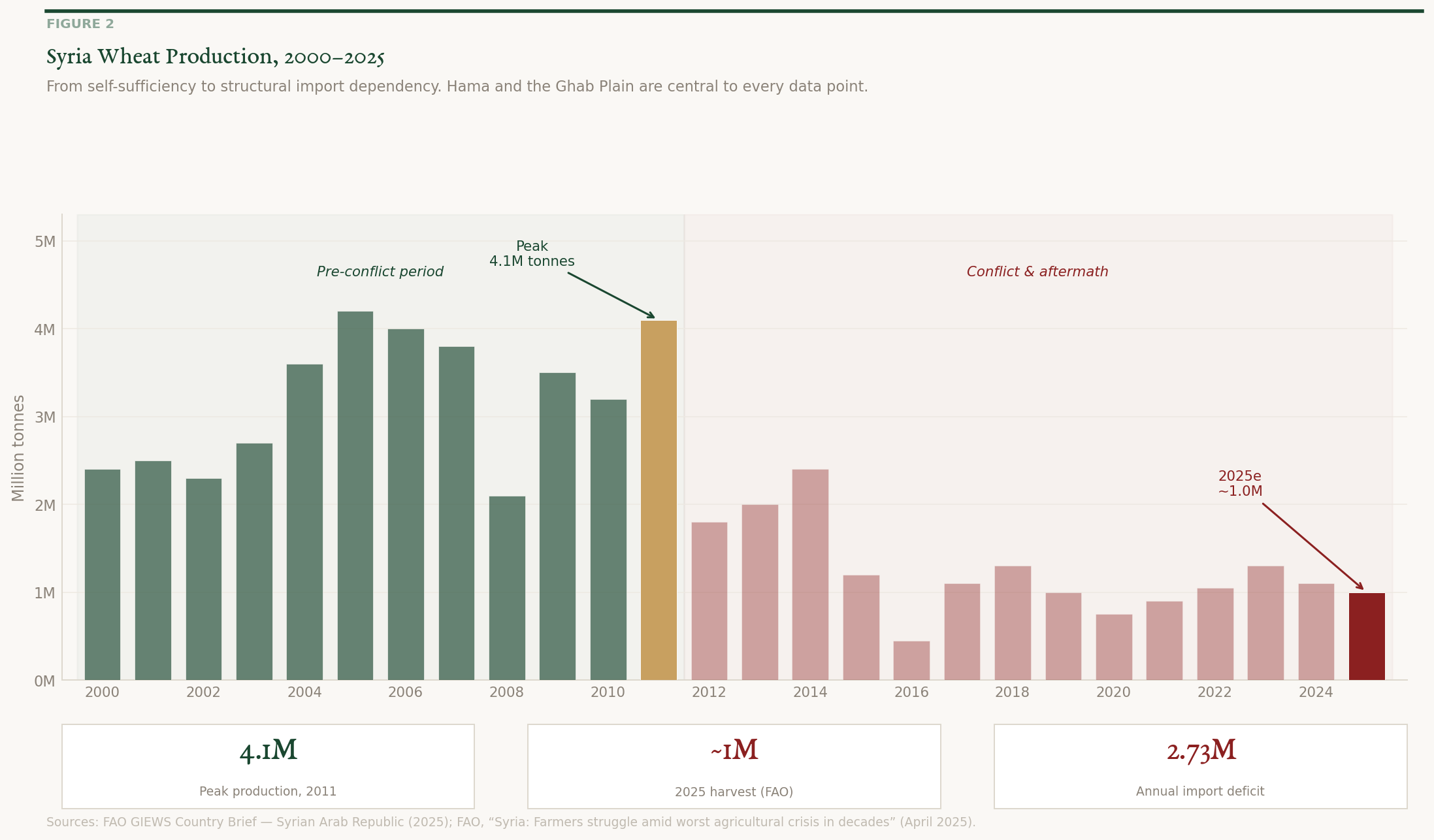
Hama Governorate was Syria’s cotton country; the Ghab Plain, the fertile valley fed by the Orontes between the coastal mountains and the interior, produced wheat, sugar beet, cotton, and pistachio at a scale that made the governorate one of Syria’s primary food basins. Cotton ginning, textile weaving, and sugar processing formed the city’s industrial identity. The governorate held 1.6 million people, roughly eight percent of Syria’s pre-war population, with agriculture accounting for 48 percent of employment. Before 2011, Syria produced an average of four million tonnes of wheat annually and was self-sufficient in cereals, Hama and the Ghab Plain were central to that figure.
Hama’s pre-war governing class left a specific mark, the Azem family produced Khaled al-Azm, five-time prime minister of Syria in the 1940s and 1950s, a man of whom contemporaries noted the Syrian lira would stabilise and foreign investment would flow whenever he took office. The Barazis produced Muhsin al-Barazi, who co-founded the League of National Action and served as premier. These were not landlords, they were the institutionally sophisticated, globally connected governing class of an independent Syria. The Ba’ath coup of March 1963 ended their role, but what it could not remove was the city’s habit of producing people of that quality, and eighty years later the diaspora that inherited that habit is in the process of doing something that has not been done for any city in the region: commissioning and funding, entirely from their own resources, a comprehensive masterplan for Hama’s reconstruction that is already in serious discussion with the Syrian government.
It was not a commercial capital in the way Aleppo was, nor a political one in the way Damascus was. Hama was something more functional and less celebrated: the agricultural engine of the western interior, the city that kept Syria fed while Aleppo kept it employed and Damascus kept it governed, its logic running in a clean unbroken sequence from fertile land to river irrigation to factory processing to highway distribution, all four operating in concert within its own governorate boundaries.
The countryside, al-reef, is a story as significant as the city itself and one that reconstruction capital has so far almost entirely overlooked. Hama Governorate is one of the most ethnically and religiously diverse in Syria: Sunni majority across the city and the Ghab Plain, Christian towns such as Mhardeh and Suqaylabiyah, Alawite and Murshidi villages in the western and northern countryside, and Circassian and Turkmen villages whose roots stretch back to Ottoman-era settlement. Salamiyeh, thirty kilometres to the southeast, is the historical seat of the Ismaili community in the Levant and a city whose international institutional connections through the Aga Khan Development Network give it a model of organised diaspora investment unlike anything the rest of the governorate has yet built. Hama Governorate is not a city with a hinterland, it is a mosaic of communities with different histories, different productive capacities, and different diaspora networks, each a distinct entry point for capital patient enough to work at that scale.
The Orontes, the Assi, “the Rebel River,” which flows north against the direction of every other river in the Levant, is the physical and symbolic backbone of Hama’s sustainability thesis. Under the Assad regime it was systematically poisoned: untreated industrial waste and sewage discharged directly into the water, factories on its banks operating without environmental regulation, turning the river from a living agricultural system into what observers described by the 2010s as little more than an open drain. The norias still turned, but the water they lifted was no longer fit for the fields it was meant to serve. The river’s degradation was not incidental, it was the physical expression of a regime that treated Hama’s resources, like its people, as things to be exploited rather than sustained. Since December 2024, early environmental monitoring has begun in the basin and communities along the Orontes are reporting the first signs of ecological recovery. Restoring the river is one of the most consequential and most tractable environmental investments in the country, because without a clean Orontes the agro-industrial processing, the irrigation rehabilitation, and the circular water loop that define the Hama thesis are all assumptions rather than foundations.
Then there is the fact that no analyst has yet treated as an advantage. Hama Governorate is the only governorate in Syria, excluding the Damascus metropolitan area, that shares no border with a foreign country, landlocked within Syria itself and surrounded on all sides by other governorates, with Idlib and Aleppo to the north, Raqqa to the east, Homs to the south, and Tartous and Latakia to the west. Where every other Syrian city can rely on cross-border supply chains, foreign labour arbitrage, or port access, Hama cannot, which means Hama must, by the sheer logic of its geography, develop the conditions for self-sufficiency. It has water from the Orontes and the Ghab aquifer, consistent solar irradiance in the central interior, wind channelled by the coastal mountain ranges, and fertile land that produced a fifth of Syria’s food before the war, the natural resource stack that a circular economy requires. The geography that looks like isolation is actually the blueprint: a governorate that can generate its own energy, process its own food, treat its own water, and construct its own infrastructure without dependence on a single corridor it does not control, and no other Syrian city can make that claim.
The geopolitical dimension of this underappreciated propostion will matter more as Syria’s reconstruction deepens. One of the structural vulnerabilities of post-conflict states is the ease with which external actors can leverage a nation’s dependency on specific corridors, inputs, imports, capital, or supply relationships as instruments of political pressure. If Hama executes the circular economy thesis, it does not merely become Syria’s most self-sufficient governorate, it becomes a proof of concept for the proposition that Syrian economic sovereignty is achievable at the sub-national level first, and scalable to the national level from there.
What Was Lost
The date every Syrian knows in connection with Hama is February 2, 1982. Hafez al-Assad sealed the city that day, cutting electricity, communications, and food supplies. Artillery opened on the old city centre. Syrian Air Force jets bombed residential neighbourhoods to clear lanes for tanks. When commanders suspected Muslim Brotherhood fighters were hiding in tunnels beneath the old city, they pumped diesel fuel into the tunnels and stationed tanks at the exits.
The siege lasted twenty-seven days. The death toll has never been formally established. The Syrian Network for Human Rights (SNHR) documented approximately forty thousand civilians dead and seventeen thousand still missing, making the 1982 Hama massacre one of the largest mass killings of civilians by an Arab government against its own people in the modern era, and among the most underreported atrocities of the twentieth century. The victims were overwhelmingly unarmed residents. A hospital administrator who managed intake at the time recalled bodies arriving by truck around the clock, the registers she kept subsequently confiscated by authorities. One survivor recalled his brother shot outside the sports stadium in front of his wife and children; authorities called two hours later to collect the body and forbade a funeral. Entire neighbourhoods, Kilaniyeh, Sharqiyah, Shamalia, Baraziyeh, were not fully rebuilt forty years later, almost every family in Hama lost someone.
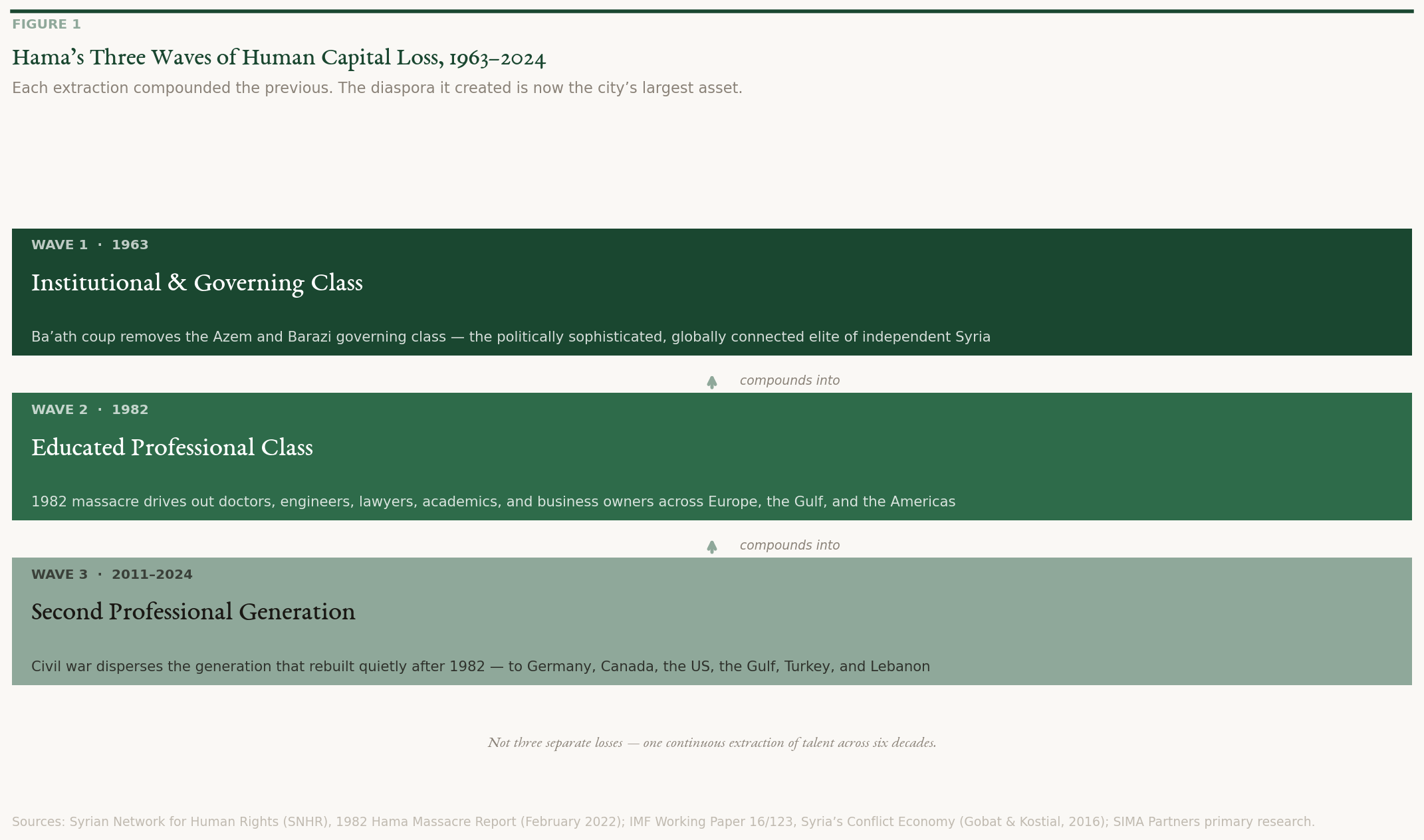
What the massacre accomplished economically was systematic. It drove out Hama’s educated professional class, the doctors, engineers, lawyers, academics, and business owners who had rebuilt the city’s civic and commercial life in the decades since 1963. They dispersed across Europe, the Gulf, and the Americas, carrying with them exactly the intellectual capital and professional expertise a city needs to modernise. Their departure was not incidental to the regime’s purpose. A city stripped of its educated class is a city that cannot organise, cannot lead, and cannot challenge, and the silence the regime wanted required the absence of the people who would have broken it.
“Hama” became a ceiling on Syrian political life, telling every subsequent protest movement what the state would do if challenged. It worked for three decades. When the Arab Spring reached Hama in 2011, hundreds of thousands filled the streets in the largest protests anywhere in Syria, and the regime responded with the same instrument it had used in 1982, killing hundreds of civilians and forcing the city into silence again, still carrying 1982, unable to accumulate the defiance a second time.
What followed between 2011 and 2024 was war, not the targeted political suppression of 1982 but thirteen years of siege, displacement, barrel bombs, and strangulation. The fighting concentrated in the rural north, Kafr Zita, Latamneh, and the Ghab Plain villages, which aerial strikes reduced to rubble. The city centre was largely spared the physical destruction of Aleppo or Homs, but the population haemorrhaged. The professionals who had survived 1982 in silence, a second generation who had rebuilt quietly across the intervening decades, finally left for Germany, Canada, the United States, the Gulf, Turkey, and Lebanon, carrying with them degrees from the best universities in the Arab world and Europe and skills that would earn them senior positions in multinationals, hospitals, and technology firms abroad. By 2024, Hama had absorbed three successive extractions of human capital across six decades. What the city lost was not wealth. It was the compounding intellectual dividend of three generations of talent.
What the city retained was the land, the geography, and the people who could not or would not leave: the farmers in the central and southern governorate who kept working through the years of conflict, the noria carpenters who kept repairing the wheels, and the families who stayed because Hama was their city regardless.
On December 5, 2024, rebel forces entered Hama without significant resistance. The Syrian Army withdrew. Residents came into the streets. Three months later, on February 27, 2025, Hama held a public commemoration of the 1982 massacre for the first time in its history. Photographs that families had kept hidden for decades were exhibited inside a church. Muslim and Christian religious figures sat in the same room. People who had not spoken publicly about what they witnessed in 1982 gave testimony. The city that had not been allowed to mourn for forty-three years began to mourn, the suppression has a start date, and now it has an end date.
What Has Changed
The national picture is established: sanctions lifted in 2025, $28 billion in investment commitments announced, Syria’s GDP beginning to recover from an 80 percent contraction (World Bank, October 2025). The relevant question for Hama is what that national turning point looks like from inside a city the regime never trusted and never built.
It looks like vacancy, the large real estate and infrastructure announcements that dominated Damascus reconstruction coverage in 2025 did not land in Hama. Saudi and Gulf investment forums oriented toward Aleppo’s industrial base and Damascus’s financial & institutional infrastructure.
That vacancy is the entry point, while Hassia Industrial City in Homs attracted ninety investment applications in five months after December 2024, and while Damascus saw $14 billion in MoUs signed at a single August ceremony, Hama received none of the headline announcements. No sovereign wealth fund has anchored its Syria strategy here, no Gulf developer has claimed the Orontes waterfront, no energy company has filed for a renewable BOT concession in the eastern steppe. The terms for every sector that matters in this governorate are still being written, and big capital follows institutional presence just as institutional presence follows private capital: the first actor to structure a credible investment in a post-conflict city shapes the terms for everyone who follows. In Hama, no one has gone first, and first-mover space in a post-conflict economy closes as certainty accumulates.
The Arithmetic
Syria’s wheat production fell from approximately four million tonnes annually before 2011 to between 900,000 and 1.1 million tonnes in 2025, a 60–75 percent decline compounded by the worst drought in sixty years (FAO, June 2025). The Ghab Plain, historically one of Syria’s most fertile zones, was specifically identified by FAO as among the hardest hit by the 2025 drought and the collapse of the Afamia dam through looting and sabotage. Syria now imports wheat from Ukraine, Romania, and Bulgaria to fill an estimated 2.73 million tonne annual deficit.
The gap between what the land can produce and what it currently produces is the investment. But the deeper arithmetic is in energy. Syria’s power generation has fallen by more than 80 percent from pre-war levels (UNDP, 2025). The national grid delivers electricity for only a few hours daily in most governorates. Hama Governorate, with its solar irradiance in the central interior, consistent wind patterns channelled by the coastal mountain ranges, and the Orontes River available for micro-hydro generation, has the natural resource base to generate its own power independently of the national grid. A governorate that can power itself can attract the manufacturing, processing, and data infrastructure that cannot function on intermittent electricity, and in Syria’s current energy environment that is not a marginal advantage but the difference between an economy that works and one that cannot.
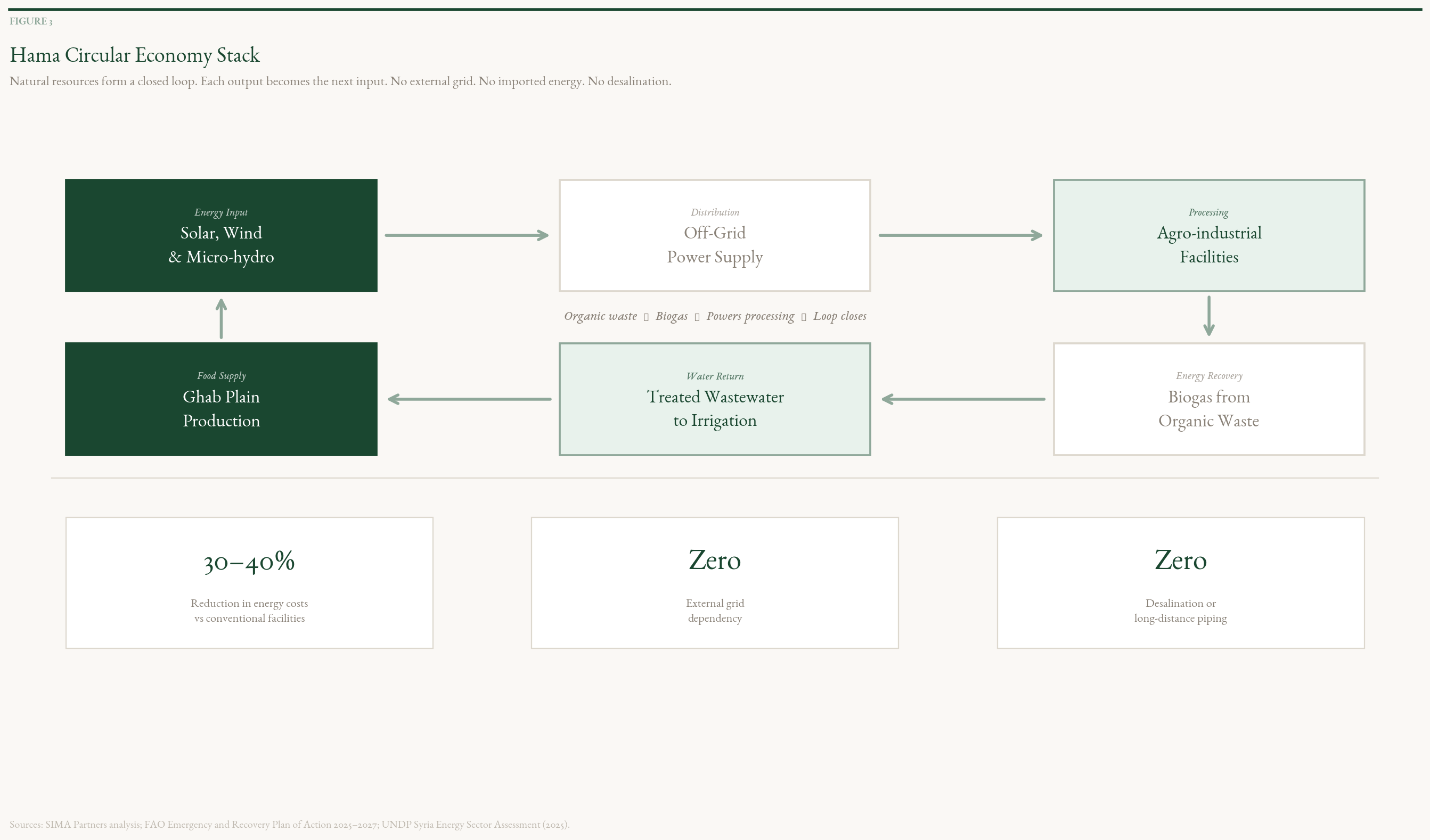
The World Bank’s October 2025 Syria reconstruction estimate of $216 billion nationally allocates the largest share to infrastructure and housing, with energy rehabilitation as the second largest category. A governorate that can close its own energy gap through renewable generation is a governorate that does not need to wait for national grid rehabilitation. The circular economy thesis for Hama, solar and wind power feeding agro-industrial processing, organic waste generating biogas, treated wastewater returning to irrigation, food production closing the loop back to energy, is not aspirational. It is the only model that makes economic sense for a landlocked governorate with the natural resources Hama possesses.
Where Capital Goes
Renewable energy: Before any other sector can function at scale, Hama needs reliable power. The governorate’s solar irradiance and wind corridor make utility-scale renewable generation viable without the grid dependency that constrains every other Syrian city. A solar farm in the eastern steppe combined with wind installations along the mountain foothills and micro-hydro on the Orontes creates a diversified generation portfolio. A private developer operating under a BOT concession, with power sold to governorate institutions and industrial offtakers and infrastructure returned to state ownership at contract conclusion, is the viable entry structure under Presidential Decree 114/2025. Capital requirement for a 50MW solar installation is in the range of $35–50 million, and the payback case is anchored by captive industrial demand that no equivalent investment elsewhere in Syria currently has.
Circular agro-industrial complex: The Ghab Plain’s agricultural output, wheat, sugar beet, cotton, and pistachio, feeds into processing that generates organic waste, which feeds biogas generation, which powers the processing, which returns treated effluent to irrigation, in a closed-loop model that agro-industrial parks in Morocco, Jordan, and Egypt’s Delta have deployed at scale. The Hama version has a natural advantage none of those possess: the Orontes River as a water source that does not depend on desalination or long-distance piping. Capital requirements for an integrated agro-processing and biogas facility run from $20–40 million depending on throughput, and the circular model reduces energy input costs by 30–40 percent against a conventional facility, compressing payback timelines materially.
Irrigation rehabilitation: FAO’s Emergency and Recovery Plan of Action 2025–2027 calls for $286.7 million to address Syria’s agricultural crisis nationally. The Homs-Hama irrigation network was specifically identified for EU-funded rehabilitation and the Afamia dam requires reconstruction. A private irrigation concession, with water fees from farmer beneficiaries and infrastructure returned to state ownership, is the most defensible BOT structure in Syria’s current regulatory environment, with entry at single-basin scale achievable at $10–30 million. The output unlocks agro-processing demand that justifies the renewable energy investment; these sectors are not parallel opportunities but a stack, each enabling the next.
Smart city and digital infrastructure: A governorate rebuilding from near-zero has what no established city possesses: the ability to design its infrastructure as native digital from the start rather than retrofitting legacy systems. Fibre to every new building, smart water metering across the distribution network, digital health records integrated with new hospital facilities, and sensor networks on the Orontes monitoring water quality and flow in real time are not luxury additions to reconstruction but the cost-efficient path, since installing digital infrastructure during construction is a fraction of the cost of retrofitting it afterward. Hama can design a twenty-year city in 2026 rather than rebuilding a 1980s city and spending the next two decades upgrading it.
Heritage and eco-tourism: Apamea, fifty-five kilometres northwest of Hama, contains one of the longest colonnaded streets in the Roman world and a theatre with an estimated capacity of twenty thousand spectators. The Orontes waterfront in Hama city, anchored by the norias, the Ottoman-era Azem Palace, and the medieval mosques, is itself a tourism product. The Ghab Plain eco-landscape of farm stays, bird watching, and Orontes river trails completes a circuit that no Syrian governorate can currently offer. A heritage hotel at the city waterfront, an eco-lodge in the Ghab, and a site interpretation centre at Apamea constitute a tourism product at $5–15 million of capital with no comparable competitor.
What Can Go Wrong
Institutional thinness: Hama did not develop a strong private sector institutional base under the Ba’ath regime because the regime never trusted the city enough to allow it. The commercial networks, banking relationships, and informal connections that in Aleppo or Damascus allow an investor to find the right counterparty are thinner here, and an investor entering without a local partner who understands the city’s particular geography will find navigation difficult in ways not visible from outside. The diaspora masterplan is actively building this institutional base, but it is early.
Energy infrastructure lag: The circular economy thesis depends on renewable energy coming online before agro-industrial demand can scale. If the BOT regulatory window under Decree 114/2025 moves slowly or the land framework for energy installations in the eastern steppe is unresolved, the investment stack stalls at its foundation layer, since the sectors are interdependent and a delay in energy delays everything downstream.
The national framework gap: Hama’s opportunity depends on the national investment environment improving at a rate that makes capital contractable and returns repatriable. As of early 2026, no comprehensive national reconstruction plan exists (Carnegie Endowment, 2025). The Investment Banks Law and SWIFT reconnection are the right moves, and the pace of their implementation determines when the opportunity closes from risk to certainty.
Communal fracture if healing stalls: Hama Governorate sits at a fault line in Syria's post-conflict geography. Its western edge borders Tartous and Latakia, the coastal governorates most associated with the communities that formed the backbone of Assad's support base, and whose populations now face their own unresolved reckoning with a regime that implicated them without their universal consent. Suqaylabiyah, within Hama Governorate itself, is a reminder that the social complexity of the coast does not stop at the administrative border. The investment thesis that links Salamiyeh's agricultural land, Mhardeh's Orontes-side farms, and the Ghab Plain villages into a single circular economy depends on a level of inter-communal cooperation that a fractured or politicised reckoning would directly undermine. The February 2025 commemoration was a beginning, not a settlement, and if the process of public acknowledgement stalls or hardens into narratives of collective guilt rather than locating responsibility in the state structures that perpetrated the violence, the latent tensions along this fault line could surface as the kind of instability that makes contracts unenforceable and capital immobile. A governorate that cannot agree on what happened cannot easily agree on what to build.
The Parallel
Halabja was gassed on March 16, 1988. Saddam Hussein’s aircraft dropped mustard gas, sarin, and VX nerve agents on a Kurdish civilian population in five hours. Between three and five thousand people died immediately; tens of thousands more suffered cancers, birth defects, and chronic illness that persist today (Supreme Iraqi Criminal Tribunal, 2010). When Saddam fell in 2003, reconstruction was pledged. Tens of millions were allocated. A memorial was built. Halabja was elevated to provincial status. Two decades later the city remains poor, underpopulated, and economically marginal. The capital arrived but reconstruction underdelivered, because the prior conditions for durable recovery, legal accountability, compensation for survivors, and a civic framework for processing collective trauma, were never fully established. Halabja became a symbol, it did not become a city.
Dresden chose differently. Firebombed in February 1945, its Frauenkirche reduced to rubble by February 15, the city spent forty-five years under East German rule that left the ruins in place as a memorial, not rebuilding but not erasing either. When reunification came, Dresden processed before it rebuilt. The Frauenkirche was reconstructed stone by stone between 1994 and 2005, using the original stones catalogued from the rubble, partly funded by Britain, including a metalsmith whose father had flown in the bomber crews. The gold cross atop the rebuilt dome was gifted by Coventry, the British city the Luftwaffe had destroyed in 1940. The act of rebuilding was an act of public reckoning, and it produced a city whose post-war identity is more durable than its pre-war one ever was.
The distinction is economic, not aesthetic. Cities that process their foundational wounds before rebuilding produce institutional reliability, the kind that makes contracts enforceable, commitments credible, and capital deployable without the risk that unresolved grievance surfaces later as instability. Cities that skip processing in favour of speed produce the opposite: reconstruction that concentrates in the hands of those closest to power, social fractures that remain live, and a civic life that cannot fully function because the event at its centre cannot be discussed.
Hama is not Halabja and it is not Dresden. But the February 2025 commemoration, photographs in a church, clergy from different faiths in the same room, testimony given publicly for the first time in forty-three years, was a signal that Hama is choosing the Dresden path. The city is beginning to name what happened before it rebuilds, and that is not a political observation but an investment-grade signal: the foundation under whatever gets built here is more solid than it looks from the outside.
What is happening in Hama is also larger than Hama. The 1982 massacre was the template for how the Ba’ath state managed dissent across Syria for four decades, and Hama’s public reckoning is therefore not only a local act of healing but the beginning of a new social contract between a Syrian state and its citizens, built on acknowledgement rather than fear, on legitimate authority rather than coercive silence. A Syria in which that contract takes hold is a Syria in which capital can operate with fundamentally lower political risk than any pre-war or wartime model suggested was possible.
The Thesis
Aleppo is the argument that Syria’s industrial economy can be rebuilt through its legacy manufacturing base. Damascus is the argument that reconstruction follows institutional formation, and that the city where the rules are written captures the first dividend. Homs is the argument that geography determines return regardless of destruction levels.
Hama is the sustainability and circular economy thesis, the argument that the only Syrian governorate with no foreign border, landlocked within Syria itself and dependent on no crossing it does not control, is precisely the governorate best suited to build an economy that generates its own energy, processes its own food, manages its own water, and constructs its own infrastructure, and that what has always looked like a geographical constraint is in fact the design specification for the most self-sufficient, climate-resilient, and replicable reconstruction model in the country.
It is also the healing thesis, and the connection between healing and sustainability is not metaphorical. A regime that governed through fear governed through the destruction of its own city’s natural resources: poisoning the Orontes, neglecting the irrigation infrastructure, treating the land as something to extract from rather than invest in. The same logic that suppressed the people suppressed the river. The ceiling on political life was the ceiling on economic life, and on ecological life too. What changed in February 2025 was not just that Hama mourned; it was that a new relationship between a city and its own future became possible.
But the most significant development in Hama is not the mourning. It is what the diaspora did with the silence while the rest of the world was still deciding whether Syria was investable.
The three extractions of talent that the Ba’ath regime and the war inflicted on Hama produced, as an unintended consequence, one of the most concentrated pools of Hama-born expertise anywhere in the world: engineers who rebuilt infrastructure across the Gulf, architects who designed urban districts in Europe, doctors who ran departments in Canadian teaching hospitals, urban planners who worked on smart city programmes in China, and academics who published in the world’s leading research journals, all of them carrying Hama with them as an identity, a debt, and eventually a project that would bring them back.
What is now underway in Hama is the return of that accumulated expertise. A network of Hama-born professionals, returning to the city on a near-monthly basis to advance the work, has been quietly assembling what is by any honest measure the most sophisticated city-level reconstruction document produced for any Syrian city: a comprehensive masterplan commissioned from internationally recognised firms in urban design, smart city infrastructure, renewable energy systems, hospital planning, and educational architecture. The plan is not yet public but is already in serious discussion with Syrian government authorities. Those who have reviewed it describe a document comparable in standard to new-district masterplans in the GCC, South Korea, and China, not aspirational sketches but a fully costed, phased, technically specified vision covering hospitals, schools, working districts, renewable energy grids, digital infrastructure, circular waste systems, and green transit corridors, designed from the ground up around Hama’s specific geography rather than imported from a generic post-conflict template.
This matters beyond Hama, Syria’s reconstruction faces a structural risk that no international conference has resolved: the gap between the scale of what is needed and the pace at which geopolitical alignment, donor coordination, and central government bureaucracy can move. The Hama diaspora model suggests a different architecture, city-level reconstruction driven by communities with deep knowledge of their cities, funded by people with genuine skin in the game, coordinated with but not dependent on the central state. It is faster, more legitimate in the eyes of the people who will live in the result, and more resilient to the great-power hesitations that have already delayed Syria’s recovery.
The norias have been turning for a thousand years, powered by nothing but the river that runs through the city. For four decades, the regime poisoned that river and the wheels kept turning, a mechanism so simple and so resilient that even the Assad state could not stop it. The Orontes is recovering now, slowly, in the way that rivers recover when the source of the pollution is gone. The diaspora is returning now, in the same way, for the same reason. The model the norias have always demonstrated, self-sufficient, requiring no external input, no government directive, no permission from anyone, is exactly the model being applied to the reconstruction of the city itself.