

This is the third in a series of city-level analyses by SIMA Insights examining Syria’s reconstruction through the lens of investable opportunity. The first two issues covered Aleppo, where the thesis rests on industrial geography, and Damascus, where it rests on institutional formation. Homs presents a different proposition entirely.
Each issue follows the same analytical framework: what the city was, what happened to it, what has changed since December 2024, where capital can go, and what can go wrong. The format is designed for investors, economic researchers, and policy professionals who need a single reference they can act on.
This analysis is written from Damascus, where SIMA Partners has been based since July 2025.
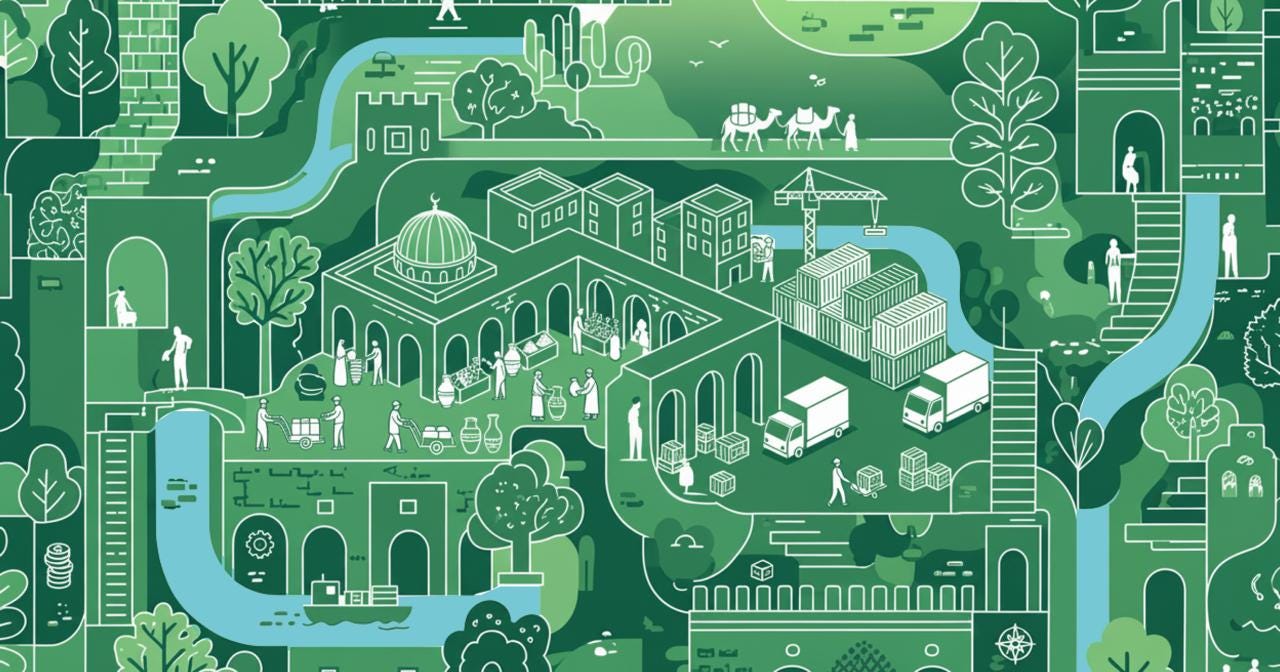
There is a useful way to think about Homs, and it is different from the way you should think about either of the two cities that preceded it in this series. Aleppo presented as a machine: a factory floor being reassembled by the industrial families who built it, powered by geographic logic that had been generating returns for five thousand years. Damascus presented as an operating system: the administrative and financial architecture through which a country of twenty-two million people is governed, and whose reconstruction is the precondition for every other reconstruction in every other city. Homs is neither of these things. Homs is a node: the physical point at which Syria’s north-south spine intersects with the only year-round passage between the interior and the Mediterranean coast. If you remove Aleppo from Syria, you lose the industrial base. If you remove Damascus, you lose the institutional centre. If you remove Homs, the centre and the south cannot reach the sea, Iraq cannot reach the Mediterranean, and the Gulf cannot reach Turkey overland.
This is not a metaphor, it is a topographic fact. Two mountain ranges run parallel to Syria’s coast: the An-Nusayriyah range in the north and the Anti-Lebanon range in the south. Between them, the mountains terminate, leaving a flat corridor nicknamed the “gateway to Syria,” the only large crossing open year-round across the coastal ranges. Through it run the highway and railroad from Homs to the Lebanese port of Tripoli, and through it, for centuries, every trader and every army moving between the coast and the interior of central and southern Syria has passed. Homs sits at the eastern mouth of this corridor, 162 kilometres north of Damascus on the M5 highway, equidistant from the capital and Aleppo, anchoring the largest governorate in Syria by surface area: 42,226 square kilometres stretching from the Lebanese border to the Iraqi desert, from the Orontes Valley to the ruins of Palmyra.
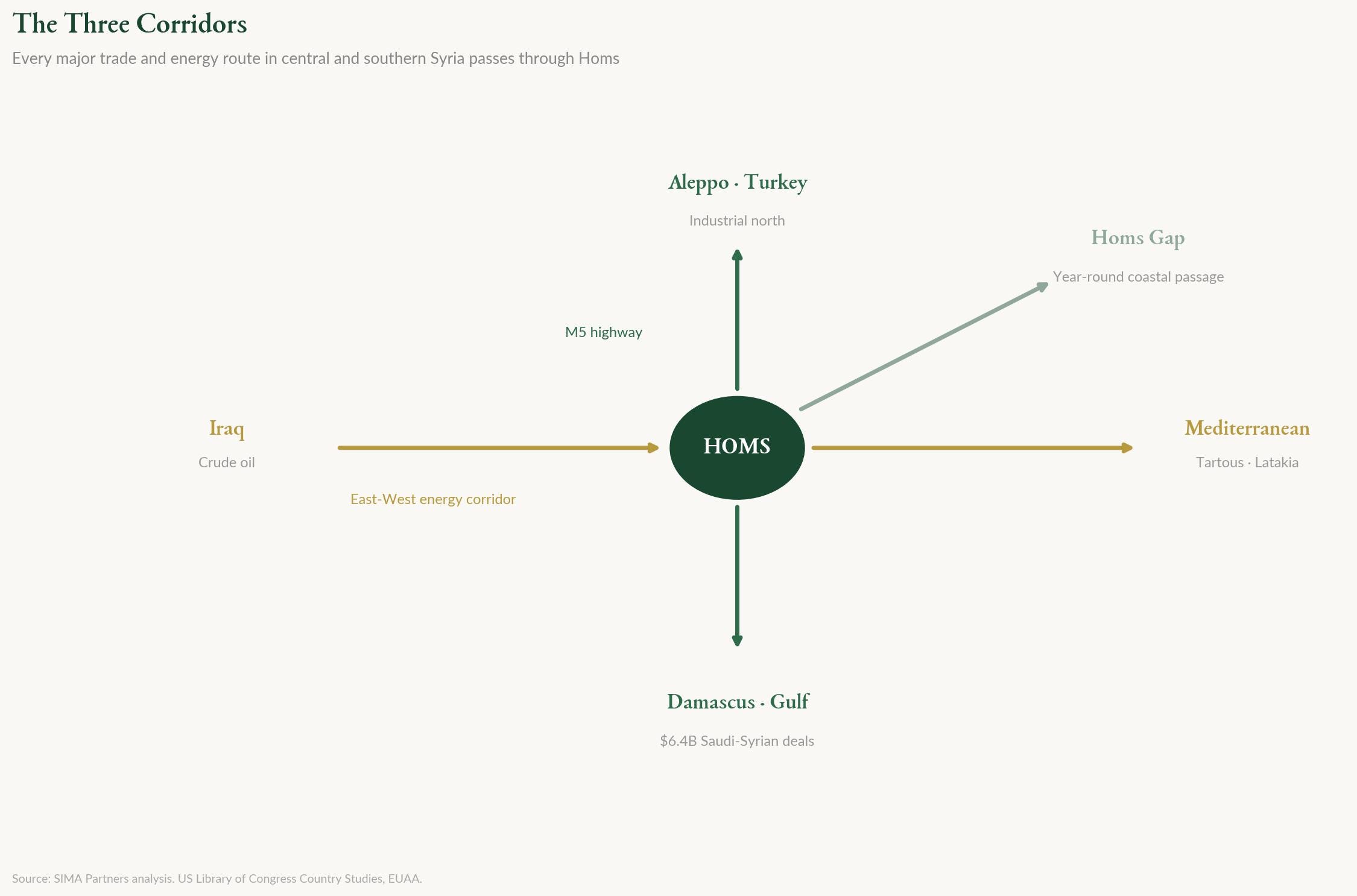
Three corridors converge here, the first runs east to west: Iraqi crude oil historically moved through Syria to the Mediterranean, processed at the Homs refinery, which opened in 1959 and operated at a capacity of 110,000 barrels per day. Any restoration of the Iraq-to-Mediterranean energy corridor passes through this city. The second runs north to south along the M5: the emerging Saudi-Turkish trade axis, propelled by $6.4 billion in Saudi-Syrian investment deals signed in July 2025, connects Gulf capital to Turkish market access via the Damascus-Homs-Aleppo highway, and Homs is the interchange. The third runs through the gap itself to the ports of Tartous, Tripoli and Latakia, the passage through which goods from Damascus, from central Syria, from Iraq, Jordan, and the Gulf reach the sea.
The crossing has been generating value at this location since the earliest settlement on the citadel mound around 2300 BCE. The Battle of Kadesh in 1274 BCE, fought on the Orontes near the city between Egypt and the Hittites, was determined by the same logic: whoever controlled the river crossing controlled the passage between the interior and the coast. Twenty-five centuries later, Salah al-Din captured Homs in 1175 specifically to block Crusader incursions from Tripoli and the castle at Krak des Chevaliers, which still stands within the governorate as a UNESCO World Heritage Site. The city has been sacked and rebuilt across every era of its history, the reason is always the same: the corridors do not move.
What It Was
By 2010, four thousand years of commercial logic had hardened into infrastructure. An oil refinery processing crude from the eastern fields at 110,000 barrels per day, a fertilizer complex drawing phosphate from Palmyra, within the same governorate, and shipping output to the coast through the gap. Sugar refineries, vegetable-oil plants, cement facilities quarrying local basalt and limestone. Textile mills tracing their origins to the Ottoman cotton boom. A dry port, a free zone, and rail connections running north to south along the M5. The Hassia Industrial City, established in 2004 on the Damascus-Homs highway, had by 2022 attracted 954 investors, employed over 25,000 workers, and generated revenues of nearly 7.2 billion Syrian pounds, its location a pure expression of the node thesis: every input arrived along one corridor and every output departed along another. Al-Baath University, founded in 1979, was the only institution in Syria offering degrees in both petroleum engineering and veterinary medicine, disciplines that mapped directly onto the governorate’s extractive and agricultural base.
The city held approximately 800,000 people and the governorate 1.76 million, contributing an estimated 7 to 9 per cent of Syria’s GDP. The commercial culture that sustained this output depended on something that does not appear in economic statistics: inter-communal trust. Homs was well known for the integration of its multi-cultural communities, and in Diana Darke’s account of the Homs souq, “Christian traders were as supported as Muslims” because commerce required trust and trust required proximity. The waqf tradition, surplus reinvested into the community rather than extracted from it, was the operating system of a merchant culture that had been extending credit across community lines for generations.
One life captures this pattern better than any data set. Mohammad Chaker Chamsi-Pasha, known as Abu Chaker, was born in Homs in 1921, took over his father’s fabric shop at the age of ten after his father’s death, barely literate, and built it into a textile business that served central Syria. Diana Darke’s The Merchant of Syria: A History of Survival, published by Oxford University Press, is one of the finest accounts ever written of the Syrian merchant tradition, and a story that reads as a playbook for every aspiring young Syrian today. Abu Chaker left Homs in 1959 to avoid Ba’athist nationalisations, rebuilt in Beirut, expanded to Saudi Arabia and Afghanistan, fled the Lebanese civil war to England where he rescued a failing Yorkshire textile mill and transformed it into a global empire, returned to Homs in 1999 because the gap was still there and the souq was still open, and left for the last time in 2011, at the age of ninety. A cloth merchant from the Homs souq who connected the looms of northern England to retail markets in Kuwait, Riyadh, Osaka, and Chongqing, because he carried the node logic in his soul: find the intersection, position yourself there, move the goods.
The capital, the knowledge, and the networks that Abu Chaker represented were not destroyed by the war. They were rerouted, the way goods are rerouted when a transit point goes down, and they remain in the system, distributed across the diaspora, waiting for the crossing to reopen.
What Was Lost
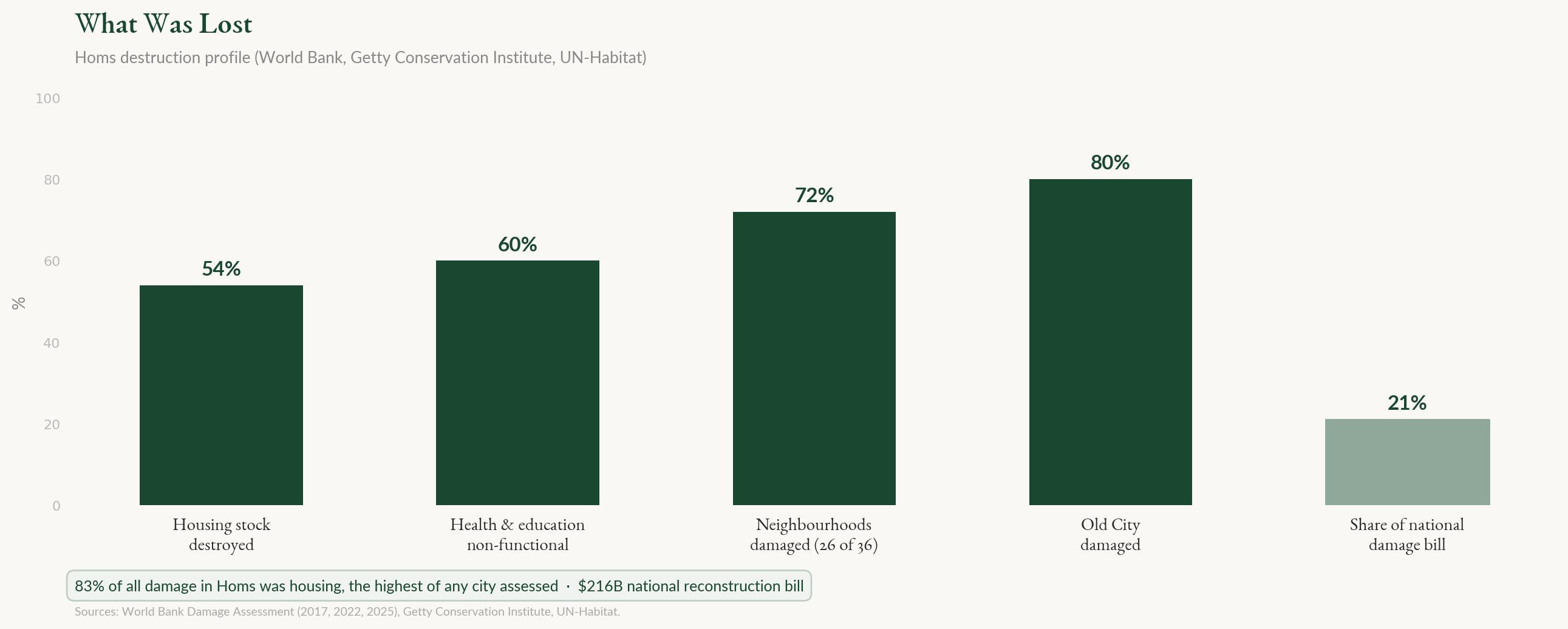
The scale of destruction is the starting point, by the time the last opposition district of al-Waer fell in 2017, 54 per cent of the housing stock in Homs had been destroyed, more than 60 per cent of educational and health facilities were no longer functioning, and 26 of 36 neighbourhoods had been partially or completely levelled. Over 80 per cent of the Old City lay in ruins. Housing accounted for 83 per cent of all damage estimates, the highest proportion of any city in the World Bank’s assessment. Homs absorbed 21 per cent of total documented damage across all assessed cities, second only to Aleppo, placing the governorate’s physical losses in the range of $1.8 to $2.4 billion at pre-conflict replacement cost. The three most severely affected governorates, Aleppo, Rif Dimashq, and Homs, require the largest share of the $216 billion national reconstruction bill.
The regime inflicted this damage with more deliberate violence than it applied to any other Syrian city, because Homs was where the revolution began in earnest and where it refused to stop. In March 2011, thousands gathered for a Friday of Dignity protest. By May, the army had entered the city. By September, communal violence had transformed a protest movement into an armed conflict. Baba Amr, a district of 55,000, became the first bastion of the Free Syrian Army. The regime’s political security directorate issued orders to “focus on sniping.” When the opposition held its ground, the deputy minister of defence travelled to Homs and delivered an ultimatum: surrender, or the regime would destroy the resistance “over the heads of the residents.” The regime meant it literally.
The bombardment killed American journalist Marie Colvin and French photographer Rémi Ochlik in February 2012. A US court later found the government culpable, ordering a $302.5 million judgment for what it called an “unconscionable” attack targeting journalists. Three months later, on May 28, Bassel Shehadeh, a twenty-eight-year-old Syrian filmmaker from Damascus who had abandoned a Fulbright scholarship at Syracuse University to return and document what was happening, was killed by government shelling in the al-Safsafa neighbourhood. The regime prevented his family from holding a funeral mass. Shehadeh had trained dozens of citizen journalists to shoot and edit footage. His last unfinished film, I Will Cross Tomorrow, documented what ordinary residents were enduring. His story, a generation that chose to witness and was killed for witnessing, belongs to any honest account of what this city lost.
The siege lasted three years. Civilians trapped in the Old City ate dried foods and grass, some 2,200 people were killed. The Old City souq where Abu Chaker had once sold his fabric, the commercial crossroads where traders of every community had operated side by side for centuries, was among the 80 per cent that was levelled.
And then, for a decade, nothing. The regime that retook Homs had no interest in rebuilding a city that had risen against it. The Arab Reform Initiative noted that the city saw “virtually no private reconstruction” in the years that followed, a deliberate abandonment dressed as neglect. The node was offline, and the regime intended to keep it that way.
The $1.8 to $2.4 billion in physical damage is an engineering problem with a known cost structure. The more consequential loss has no price tag and no timeline. Homs had been a city whose commercial culture depended on inter-communal trust, the social infrastructure that allowed traders of different backgrounds to extend credit, share supply chains, and operate across community lines without friction. The war shattered that trust through targeted displacement along communal lines. Rebuilding the physical node is a question of capital. Rebuilding the trust that made the node function at full efficiency is a question of governance, reconciliation, and time, and it is the binding constraint on whether the rebuilt crossroads operates at its pre-war capacity or at a fraction of it.
What Has Changed
The liberation of Homs on December 8, 2024 was the strategic event that ended the Assad regime. The city sits on the M5 between Damascus and the coastal governorates where the regime’s remaining military assets were concentrated. Its capture severed the capital from its support base, making the regime’s position untenable within days. The same logic that sustained Homs as a commercial crossing for four thousand years decided the military outcome of the war in less than a week.
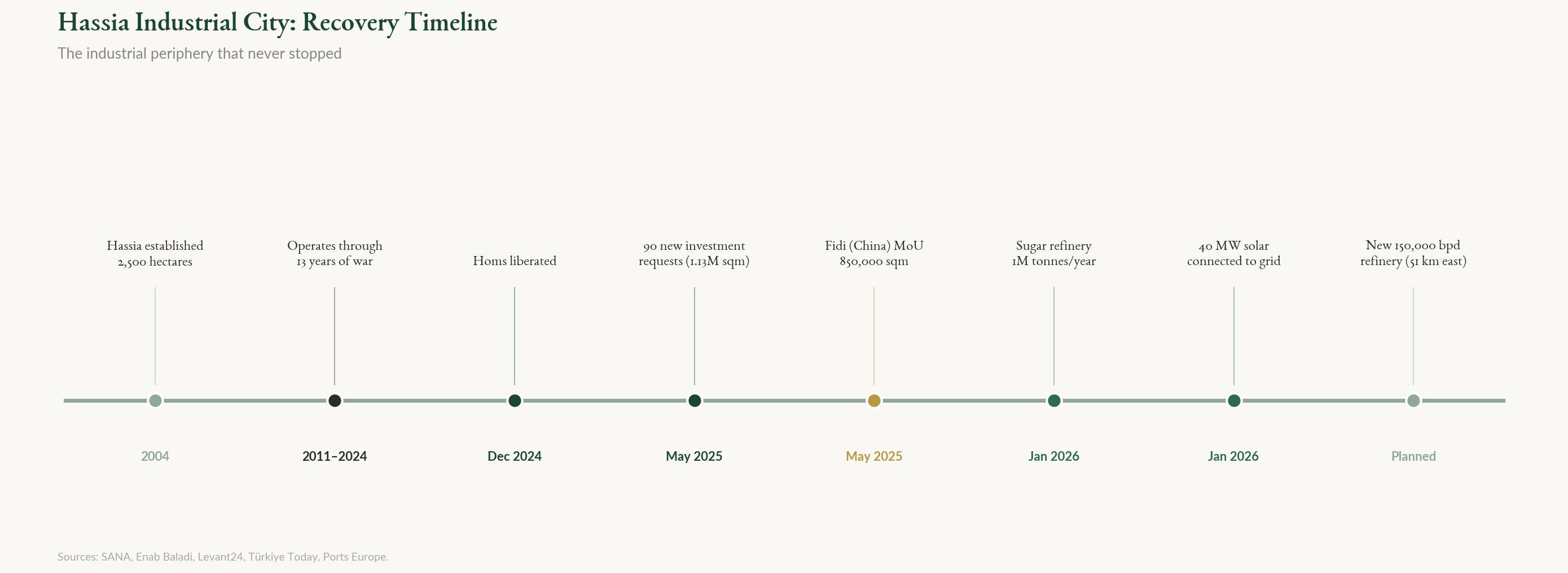
The sixteen months since then have altered the investment conditions more than the preceding decade, and the most instructive development is where the recovery is appearing. Not in the destroyed city centre, in the industrial periphery. The Hassia Industrial City received 90 new investment requests in the first five months of 2025, covering 1.13 million square metres, from local, diaspora, Arab, and foreign investors. China’s Fidi Contracting signed an MoU for exclusive rights to 850,000 square metres of the Hassia Free Zone. The largest raw sugar refinery in Syria, Madina Food City, 3,000 tonnes per day, roughly one million tonnes annually, built by a Tunisian company using German technology, began operations at Hassia in January 2026. Forty megawatts of solar were connected to the grid from the zone.
At the same time, families are returning to the destruction belt. AFP journalists observed dozens of families arriving by bus from northern Syria in early 2025, many tearful, stepping into neighbourhoods where every third building is a shell. “We removed the rubble, laid a carpet, and moved in,” said one returnee in Khalidiya. The periphery is attracting capital. The centre is attracting people. Both signals matter.
The anchor capital event is the refinery transition, the existing Homs refinery is slated for closure, with a new 150,000 bpd refinery to be constructed 51 kilometres east of the city. The old refinery site will be converted into an integrated service and residential zone. Syria’s energy sector requires an estimated $10 billion in oil and gas rehabilitation and officials estimate more than $30 billion for the broader energy system. A new gas well in the Homs countryside was inaugurated with a capacity of 130,000 cubic metres per day.
The digital corridor is being laid in parallel. The SilkLink Project, a 4,500-kilometre optical-fibre backbone won by Saudi Arabia’s STC Group for $800.2 million, includes switching centres near Palmyra, within Homs Governorate. If Homs was the transit point for crude oil and cotton in the twentieth century, its position may make it the transit point for data in the twenty-first.
Where Capital Goes
The Homs opportunity set is distinct from both Aleppo and Damascus. Aleppo is industrial, Damascus is institutional, Homs is logistical and extractive, and the sequencing of capital deployment follows a dependency chain that mirrors the node structure itself. Three tiers of investment activate in order, each enabling the next.
The first tier is corridor infrastructure: the sectors that serve the three corridors directly and that generate returns before the city centre is rebuilt. This is where capital moves first, because the corridors are already flowing.
Energy and refining: the existing refinery operates at 30 to 40 per cent of its 110,000 bpd capacity; the Baniyas refinery at 80 per cent of its 130,000 bpd. Combined pre-war capacity was 240,000 bpd. The planned replacement refinery, the new gas well, and the $10 billion rehabilitation programme create a capital absorption surface extending from upstream exploration through midstream transit to downstream processing. The brownfield conversion of the existing refinery site into a mixed-use urban district is a secondary opportunity within the primary one. Chevron’s deal with SPC to explore offshore reserves and $28 billion in Gulf energy investment received by Syria in 2025 confirm the scale of international interest.
Logistics, warehousing, and transport: Syria has no modern logistics infrastructure, and every corridor that carries reconstruction materials passes through or near this city. Cold-chain facilities, bonded warehousing, container handling, and intermodal transfer hubs are absent and needed. The Hassia dry port and rail connections provide a foundation, but the scale of what is required, warehousing and distribution capacity for a $216 billion national reconstruction, has not yet been built anywhere in the country. The capital that builds it at the crossroads captures the throughput of the entire reconstruction, not merely the local market.
Industrial manufacturing: Hassia operated through the war and is now the fastest-expanding industrial zone in Syria. The manufacturing base is positioned to supply construction materials, processed foods, and chemical inputs that every other city will need during its own rebuilding. The question is whether Hassia can scale from its current 2,500 hectares to absorb the demand that the national reconstruction will generate.
Second tier is population services: the sectors that follow corridor activity, because the workers and families drawn by Tier 1 employment need housing and medical care. Demand here is derivative of corridor throughput, not independent of it.
Housing and urban development: Fifty-four per cent of housing destroyed, twenty-six of thirty-six neighbourhoods levelled. This is a ground-up construction market, and it will accelerate as Hassia’s expansion and the refinery transition draw labour back to the governorate. Property-rights challenges that complicate Damascus’s destruction belt apply with equal force.
Healthcare: More than 60 per cent of health facilities in Homs are non-functional. The governorate’s 1.5 million people have virtually no access to advanced diagnostics or specialist care. Primary Care, nephrology, radiology, and laboratory services represent the most acute gaps. As with housing, healthcare demand will scale with the population that corridor activity attracts.
Third tier is maturity signals: sectors that require institutional stability, physical security, and baseline infrastructure that do not yet exist at scale. These are longer-horizon opportunities, contingent on Tier 1 and Tier 2 success, but they are structurally embedded in the geography.
Digital infrastructure: The SilkLink backbone and the Palmyra switching centres position the governorate on Syria’s emerging data corridor. The Middle East data centre colocation market is projected to attract $33.79 billion in investment between 2025 and 2030. Hassia’s combination of available land, solar capacity, and central geography makes it a candidate for precisely the kind of infrastructure the Gulf is deploying at scale.
Tourism and heritage: Krak des Chevaliers, the Khalid ibn al-Walid mosque, the Wadi al-Nassara, and the Palmyra ruins, all within the governorate, constitute a heritage portfolio with no equivalent elsewhere in Syria. Tourism requires security, connectivity, and hospitality infrastructure that do not yet exist, but the underlying assets are intact and the governorate’s geographic centrality means that any future tourism circuit connecting Damascus to Aleppo will pass through Homs.
What Can Go Wrong
The risk register for Homs is the most layered in the series, three risks are specific to this city.
The first is communal fragility: the war in Homs produced the most acute communal displacement of any Syrian city, and reconstruction that proceeds without addressing return and reconciliation risks reproducing the conditions that produced the conflict. The transitional government has not yet articulated a Homs-specific reconciliation strategy. The social architecture on which the node economy depended, the inter-communal trust that allowed traders of different backgrounds to extend credit, share supply chains, and operate across community lines, was the first thing the war destroyed and will be the last thing rebuilt. An investor can price physical damage, pricing the absence of social infrastructure is harder, and it is the variable that will determine whether the rebuilt node operates at its pre-war efficiency or at a fraction of it.
The second is security: in the absence of formal governance structures across much of the fractured communal belt, vigilante groups and informal security actors are filling the vacuum. The longer the institutional gap persists, the more entrenched these actors become and the harder they are to displace through formal channels. Separately, the eastern reaches of the governorate, stretching toward Palmyra and the Iraqi desert, face a different threat: ISIL cells persist in the desert, and the security environment there bears no resemblance to the secured western corridor around Hassia, the M5, and the city proper. Capital evaluating Homs must price these two environments separately.
The third is institutional absence: the Arab Reform Initiative’s observation that Homs saw “virtually no private reconstruction” for a decade was not a market failure. It was a policy choice by a regime that no longer exists. The question is what replaces that choice. As of April 2026, Homs has no publicly announced reconstruction authority, no master plan for the destruction belt, and no property-rights resolution mechanism equivalent to the Jobar Board of Trustees framework that emerged in Damascus. Hassia’s investment demand demonstrates that capital is willing to deploy in the governorate. Whether the transitional government can create the regulatory clarity, the property-rights framework, and the procurement transparency needed to channel that demand from the industrial periphery into the destroyed city centre is the binding constraint on every other opportunity in this briefing.
The standard risks, electricity, property rights, and the political trajectory of a transitional government that is sixteen months old, apply here with the same force as in Damascus and Aleppo.
The Parallel
Mostar is the closest precedent, the city sits on the Neretva River in southwestern Bosnia, controlling the only reliable passage between the Adriatic coast and the Bosnian interior, and it was destroyed for precisely that reason. The Old Bridge reopened in 2004, private investment followed, and the node recovered, the crossing today moves people and goods as it always did, and the city functions by every measurable economic indicator. But twenty years after the ceasefire, Mostar has separate schools, separate municipal administrations, and a commercial life that operates in parallel rather than in common. Reconciliation was not deferred, it was never seriously pursued. The result is a city that works as a crossing and fails as a city; its geographic recovery complete, its social recovery absent, and the gap between the two now structural rather than transitional. Homs is not Mostar, but the gap is available to study, and the lesson is that it does not close on its own.
The Thesis
Every post-conflict reconstruction in the modern era has followed the same sequence: international donors commit funds, central governments allocate contracts, and rebuilding proceeds from the institutional centre outward. What is emerging in Homs is the opposite; recovery is being led from the industrial periphery inward, driven not by government spending or donor aid but by private capital responding to geographic logic. Hassia is taking investment while Baba Amr is still rubble, the sugar refinery is running while the Old City souq remains a shell. This is not a failure of planning, this is the market recognising that the crossroads generates returns before the city centre does, and that the periphery’s industrial activity will eventually generate the demand, the employment, and the tax base that makes centre-city reconstruction economically rational rather than merely symbolic.
If this model holds, it will matter far beyond Homs. Raqqa, Deir ez-Zor, and every other Syrian city where the centre was destroyed but the periphery survived will face the same question: does reconstruction begin with the institutions or with the geography? Homs is producing the first answer, and the answer is that geography moves first.
Abu Chaker Chamsi-Pasha’s life was not, in the end, only a story about positioning at intersections. It was a story about survival through adaptation, he lost everything twice, in Homs and in Beirut, and each time he read the new environment, moved to wherever the corridors were flowing, rebuilt with whatever materials and markets were available, and kept his network alive from the other side of the world. He did not wait for conditions to improve, he operated within the conditions that existed. It is what the consortium did when it built a million-tonne sugar refinery in a governorate where half the housing stock is rubble. It is what the woman in Khalidiya did when she laid a carpet on the floor of a burned-out house and moved her children in. The pattern is the same at every scale: survive, adapt, rebuild where you are, and trust that the crossing will reward those who adapted.
The city that produced Abu Chaker does not need to return to what it was before the war. What it was before the war was already constrained by the regime that would eventually destroy it. What the geography, the corridors, and the pattern of survival suggest is something that has not existed before: a Homs rebuilt not by a state but by the accumulated commercial intelligence of a diaspora that learned to operate in Beirut, in Bradford, in Riyadh, and across three continents, returning now to the original crossing with capital, expertise, and networks that the pre-war city never had access to. This will only work if the reconciliation keeps pace with the capital, commerce can rebuild a crossroads, it cannot, by itself, rebuild the trust between communities that made the crossroads function.
The reconstruction dividend in Homs is not merely the recovery of what was lost. It is the possibility that what comes next will be larger than what came before, because the crossing is open, the corridors are flowing, and the people who know how to build at intersections are, for the first time in fourteen years, free to come home.